Algorithm demos
Seven extractors, side by side, on the same fields and the same grids, in one process. That last part is the point: most published comparisons are not comparisons at all, but one algorithm on one machine against a number someone else measured on another.
Several figures here contradict what the literature says. Where they do, the contradiction is the
finding — FINDINGS.md records which source to distrust and why.
Where the root falls decides the whole gain, and the curve is closed-form
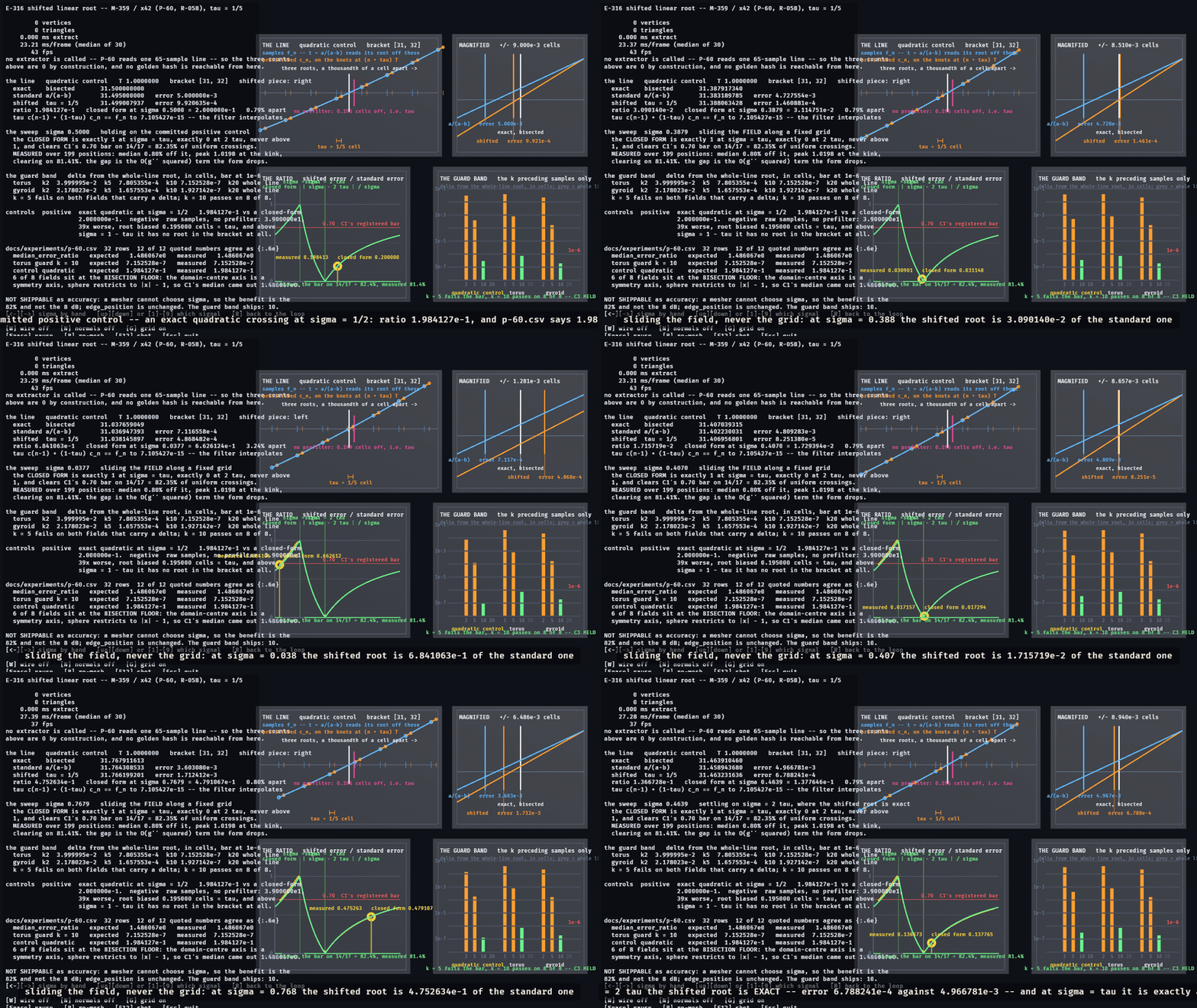
shifted_linear_root — one grid line, 65 samples, no extractor called anywhere. The samples are fixed
markers; the field slides along the line so the crossing sweeps its cell, which is what a mesher
actually experiences. Behind the measured point sits the closed-form curve, and the two agree to a median
of 0.8%.
Every Marching Cubes vertex is t = a/(a−b) between two corner samples — linear interpolation, the oldest
reconstruction there is. Blu, Thévenaz & Unser show that you can do materially better for the same cost by
shifting the sampling knots by a fixed, signal-independent τ and enforcing the interpolation
property with a prefilter: "about 8 dB asymptotically", and "for ω < 3π/4 the optimally shifted method
outperforms the nonshifted one". The optimum is τ_opt = ½(1 − √3/3) ≈ 0.21, and at the practical
τ = 1/5 the prefilter
cₙ = −2⁻²·cₙ₋₁ + (1 + 2⁻²)·fₙ
is multiplication-free — two shifts and two adds per sample, with the paper's own c₀ = f₀.
That is a claim about the reconstruction. A mesher does not consume the reconstruction; it consumes one number out of it, the root position. Does the 8 dB transfer?
It transfers exactly, and the answer is a ratio rather than a constant. For a locally quadratic signal
the shifted reconstruction's error over a cell is (g″/2)·[τ² − τ + s(1−s)], so for a root at fraction σ
of the cell the two root errors stand in the ratio
|σ − 2τ| / σaboveσ = τ, and(σ + 3/5)/(1 − σ)below it
which at τ = 1/5:
| where the root lands | ratio | meaning |
|---|---|---|
σ = 2τ = 0.4 |
exactly 0 | the shifted rule is exact |
σ = τ = 0.2 |
exactly 1 | the root is on a knot; no gain at all |
| anywhere in the quadratic regime | ≤ 1 | never worse than standard |
82% of uniform σ |
≤ 0.70 | clears a 30% bar |
Slide the crossing in the demo and the measured ratio rides that curve: nose-diving to zero at 0.4,
coming back to 0.992 at 0.2 against a predicted 1, never exceeding 1.02 anywhere over 199 sampled
positions. So the pre-registered clause — "at least 30% lower on the smooth fields" — is falsified, at a
median ratio of 1.486, and it deserved to be: a median over four arbitrary crossing positions was a
lottery over σ. The honest number for a mesher, which cannot choose σ, is the 82%, not the 8 dB.
Half of that median was arithmetic rather than measurement, and the demo says so. On six of the eight
reference fields the domain-centre axis is a symmetry axis: sphere restricts to |x| − 1 along it and
torus to ‖x| − 1| − 0.3, both piecewise linear through the first crossing. With g″ = 0 both
reconstructions are exact, root_error_standard is the bisection floor 7.1e-15, and the ratio is the
quotient of two numbers at f64 resolution. Only two fields carry a real measurement, and they split —
fbm_terrain is 4.9× better, gyroid is 2× worse because its crossing sits at x = −π exactly, an
inflection point of sin where the second derivative vanishes and the error is cubic-dominated, outside
the closed form's regime.
Two controls are on screen, and they are why the rest is trustworthy. The positive control is a
synthetic exactly-quadratic line whose predicted ratio is exactly 1/5; it measures 0.1984, which pins
the pole sign, the filter gain, the knot offset and the two-piece segment choice all at once. The
negative control feeds the identical code path the raw samples instead of the prefiltered c — the
shift applied without the prefilter that makes it interpolate, which is the most natural way to get this
wrong — and returns 39× worse than the standard rule, with the root biased by 0.195 cells, i.e. τ.
A positive control that passes while a negative control also passes is telling you nothing.
What ships out of this is the guard band. The prefilter is causal and global: cₙ depends on every
earlier sample, with weight (τ/(1−τ))^k = (1/4)^k. A chunked mesher cannot see every earlier sample, so
the question is how much overlap it needs.
k = 2 |
k = 5 |
k = 10 |
|
|---|---|---|---|
torus |
3.999995e-2 | 7.805355e-4 | 7.152528e-7 |
gyroid |
2.178023e-2 | 1.657553e-4 | 1.927142e-7 |
Ten samples, and the recovered root is within 1e-6 cells of the whole-line answer on 8 of 8 fields.
Five samples fails on both fields that carry a non-zero delta, so 10 is the real threshold rather than a
loose one, and the two steps track (1/4)³ and (1/4)⁵ to within a few percent.
Nothing in the shipped extractor changed. edge_position still computes a/(a−b); this is a 1-D
instrument, it calls no extractor, and no golden hash can move.
cargo run --example shifted_linear_root --release # 1-8 pick the field, arrows slide the crossing
Twelve quantities reproduced live from docs/experiments/p-60.csv, all agreeing (M-359 / ✗42, P-60,
R-058).
Proving a cell empty when the Lipschitz ball cannot
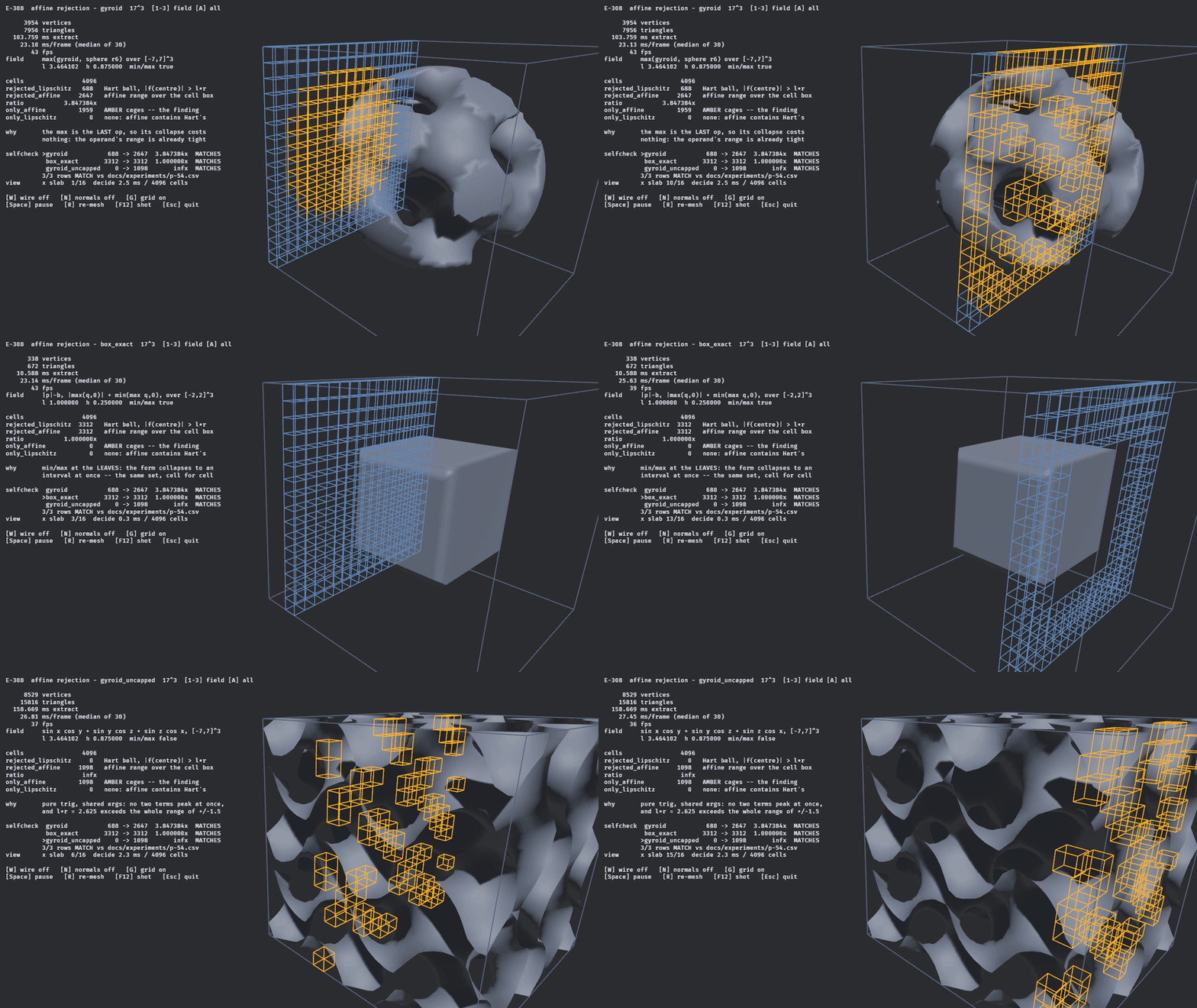
affine_rejection — one slab of a 17³ grid at a time. Slate blue cages are cells both bounds reject;
amber cages are the ones only the affine form rejects, and they are the finding: 1,959 of 4,096 on
gyroid. Cycle to box_exact and every amber cage disappears.
A conservative empty-cell test asks whether the surface can possibly pass through a cell. Hart's Lipschitz
bound answers with a ball: |f(centre)| > l·r. That throws away everything except one number.
gyroid is sin x cos y + sin y cos z + sin z cos x, and no two of those terms can peak at once — a
per-term bound cannot know that, so it declares l = 2√3 ≈ 3.464 and M-267 measured the real gradient
supremum converging to 1.731. The bound is sound and loose by 2×, on the one field where rejection pays
least.
A revised affine form carries three noise symbols plus an error accumulator — five f64, fixed
size, never growing, no heap — and bounds the whole expression over the cell's box. It keeps the
correlation. Measured: gyroid 688 → 2,647 cells rejected, 3.85×, with 1,959 gained and zero
lost. On gyroid_uncapped Hart's test rejects nothing at all, 0 of 4,096, and the affine form
rejects 1,098.
The demo's better half is where it fails. On box_exact the ratio is exactly 1.000000 and the two
rejected sets are identical, cell for cell. That field is built from min/max, for which no affine
rule exists — the only sound treatment collapses the form to an interval and destroys every correlation
it was carrying. On csg_difference it is actually worse, losing 17 cells, because it pays the collapse
and gets nothing back. A mechanism that wins everywhere is usually a measurement error; this one wins
exactly where its story says it should.
The mesh is byte-identical on all 12 rows, checked two ways, and the harness re-runs every field with Hart's constant deliberately divided by 4 to prove the check can fail — it detects the sabotage on all six. Cost is recorded and gates nothing: roughly 12× the arithmetic per cell. This is a capability, not a speedup (M-354).
cd bevy_isomesh && cargo run --example affine_rejection --release
1–3 field · A all cells vs one slab · G grid · Space pause.
The spheres a mesh never touches
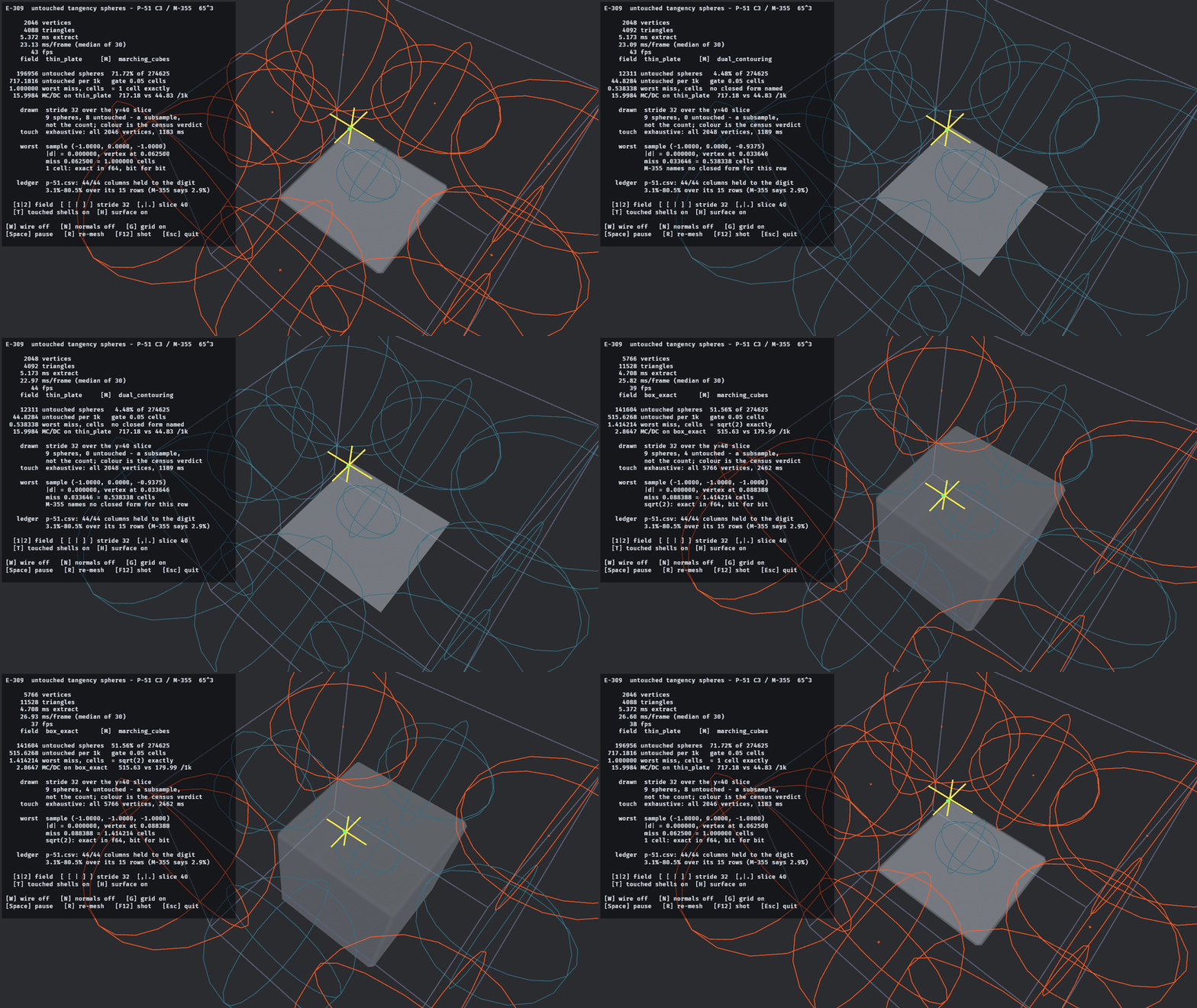
untouched_spheres — every SDF sample drawn as the sphere of radius |d| it actually asserts. Coloured
by whether any mesh vertex reaches tangency with it. On thin_plate under Marching Cubes, 717 per
1,000 are never touched; switch to Dual Contouring and the same shells go quiet — 44.83, a measured
15.9984×.
A signed distance sample says more than "the field is d here". It says the ball of radius |d| holds no
surface, and that the surface touches that sphere somewhere. Every extractor in this crate reads d
as a number to interpolate and discards both halves.
The first half turns out to be respected already, which is a useful negative: Marching Cubes pierces 0 of 22,790 vertices and Dual Contouring 0 of 22,798, searched exhaustively, two of the worst margins actually negative. The second half is wide open — 3.13% to 80.47% of samples have a sphere no vertex ever comes near, on every field, for every extractor, with no search cutoff to blame.
The worst misses are exact geometric constants, not noise, and the demo prints each witness:
box_exactunder Marching Cubes misses by exactly√2cells. The sample is the box corner,|d| = 0— a zero-radius sphere lying on the surface — and MC places no vertex on a box edge or corner at all, because both endpoints of every spanning grid edge there havef = 0and there is no sign change.- Under Dual Contouring the same corner misses by
1/√2, because DC's vertices live on the dual lattice, half a cell off the sample lattice. (Inf64it is1/√2 + 1.77e-9, and even that residual is derivable: the cell clamp insets the vertex perpendicular to the miss, which enters a distance at second order and is independent of resolution.)
Untouched count needs no ground truth — only the field and the mesh — so it is a reference-free detail-loss signal, computable on a chunk a game has already meshed (M-355).
cd bevy_isomesh && cargo run --example untouched_spheres --release
1–5 field · M extractor · [ ] sphere subsampling · Space pause.
Ninety-nine percent of a voxel grid is not surface
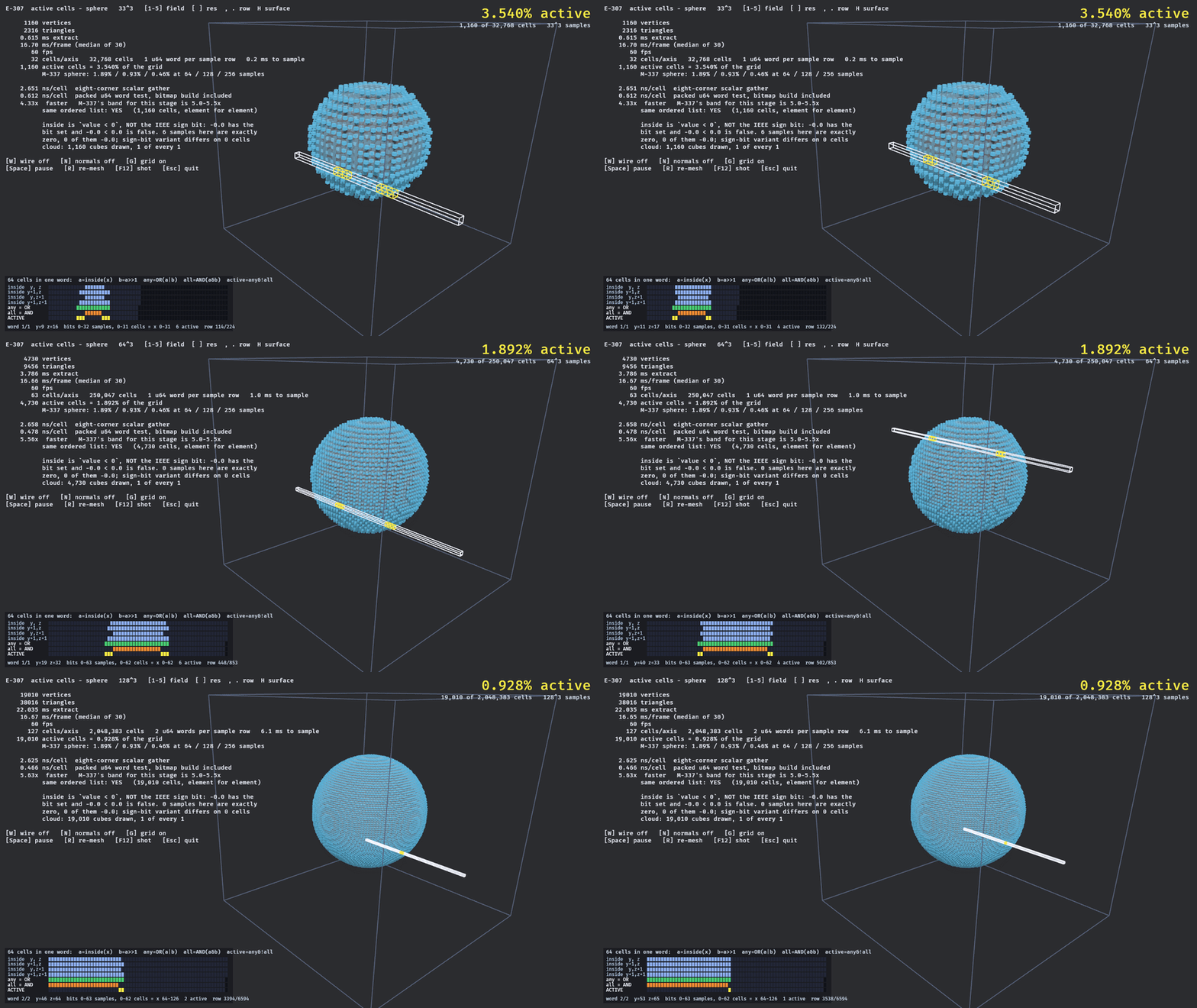
active_cells — the cells a dual mesher must actually look at, drawn against the grid it must not. On
sphere the active fraction falls 3.54% → 1.89% → 0.93% as the grid goes 33 → 64 → 128, while the
absolute count rises. That ratio falling is the entire justification for the mechanism.
A dual mesher used to gather eight corners and count insides for every cell, then throw away 97% of
that work. The active-cell test is really one bit per sample: pack value < 0 into a u64 along x,
and one fused expression over the four rows bounding a cell row decides sixty-four cells at once —
any = OR(w | w>>1), all = AND(w & w>>1), active = any & !all. The strip in the HUD shows a real
row's word and its three fused results, so you can watch sixty-four cells being decided in one
operation.
The honest number is a count, not a stopwatch. M-348 falsified the original wall-clock claim — the
ratio read 1.336×, 1.192× or 1.022× depending on who else was using the machine. What the mechanism
actually does is remove gathers, and that is an integer: at 128³ it removes 99.07% of them on
sphere, 98.35% on fbm_terrain, 95.85% on gyroid, identically on every machine (M-349). The demo
times both predicates live and shows the ratio, and also asserts the two produce the same ordered
list — an order difference would change every vertex index downstream.
One line on screen exists to stop a future shortcut. The bit is value < 0, not the IEEE sign bit.
-0.0 has the sign bit set while -0.0 < 0.0 is false, so a sign-bit build would be faster, would pass
every timing clause, and would change a reference field's mesh. box_exact is selectable so the caution
is not abstract.
cd bevy_isomesh && cargo run --example active_cells --release
3/5 field · [ ] resolution · . step the cursor row · H surface on/off · Space pause.
Marching Cubes, resolution sweeping
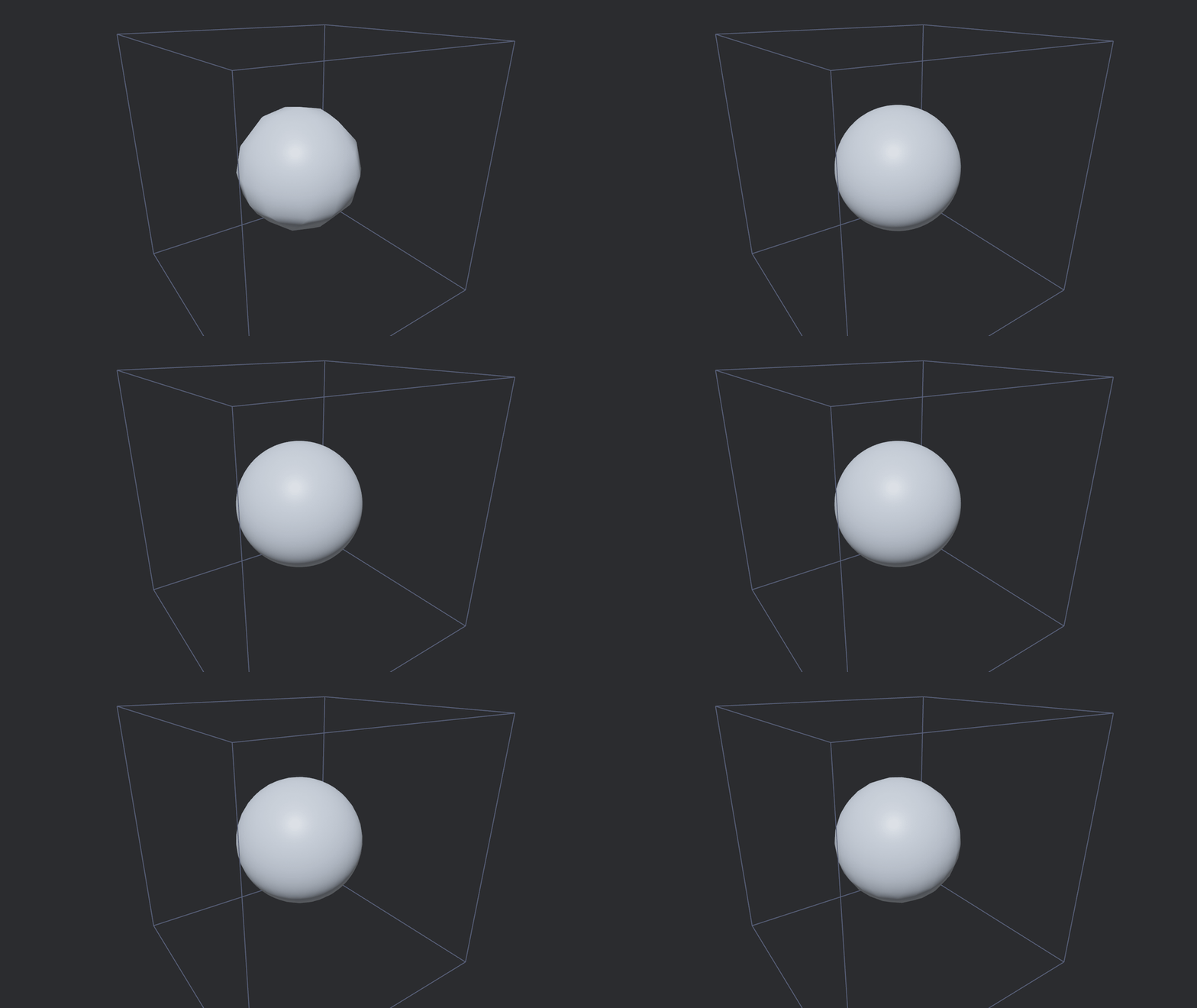
Marching Cubes over a sphere SDF, resolution sweeping from 9³ to 81³. The readout is not decoration —
it is the crate's own validity harness, re-run on the mesh being displayed every time it changes.
χ = 2, zero non-manifold edges, zero boundary edges, every frame.
cd bevy_isomesh && cargo run --example marching_cubes_sphere --release
What it looks like
use isomesh::{MeshBuffer, RuntimeShape3};
use isomesh::fields::Sphere;
use isomesh::mc::MarchingCubes;

let mut mc = MarchingCubes::<f32>::new();   // owns its scratch; reuse across chunks
let mut out = MeshBuffer::<f32>::new();     // caller-provided; reset() keeps capacity

let shape = RuntimeShape3::new([33; 3])?;
mc.extract(&Sphere::canonical(), &shape, [-2.0; 3], 0.125, &mut out)?;
Anything implementing Sdf works as input; anything implementing MeshSink works as output. bevy_isomesh::MeshBuilder is a sink whose buffers are a Bevy Mesh's attribute arrays, so extraction writes straight into the asset with no intermediate copy.
Two algorithms, side by side
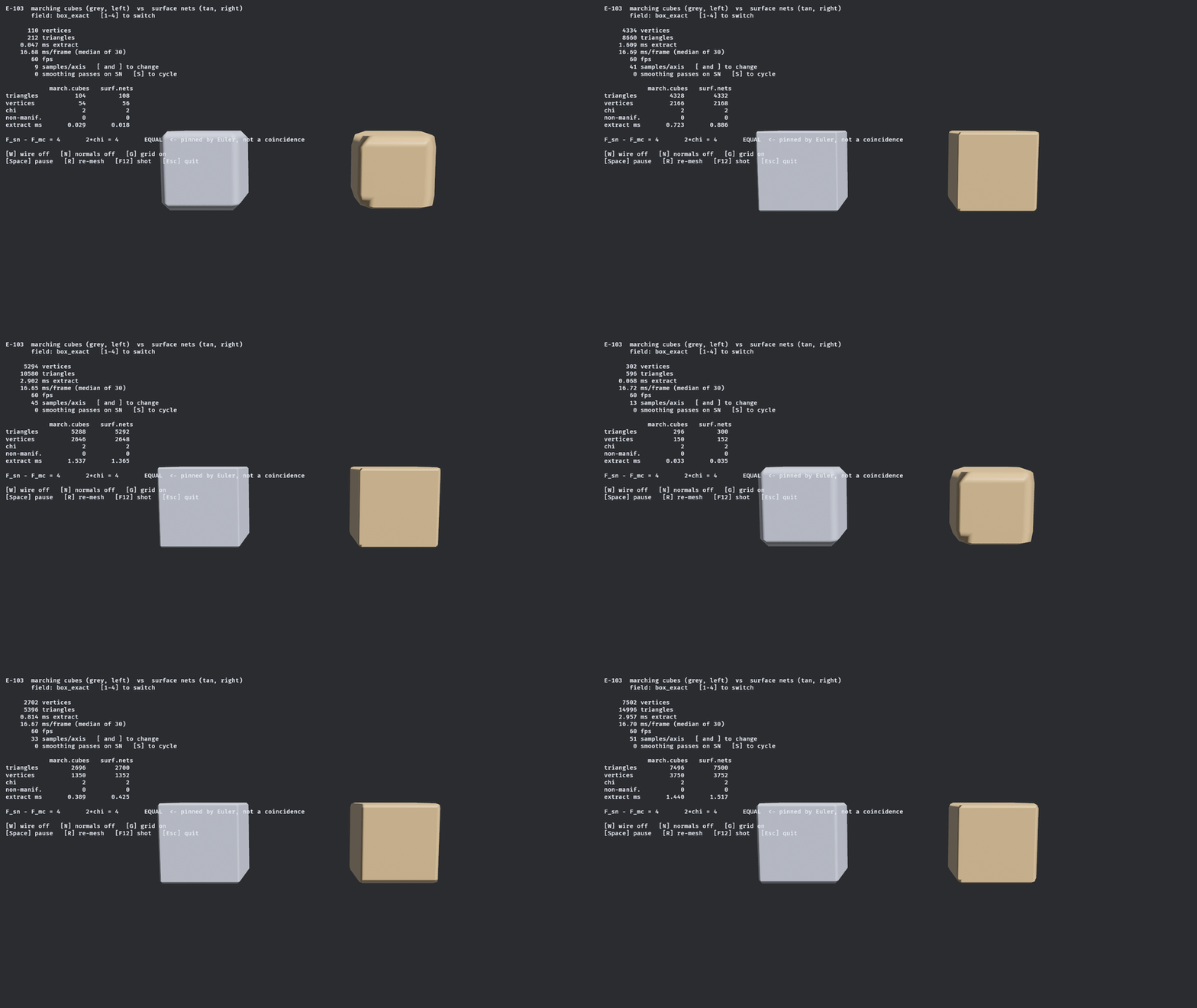
Marching Cubes (grey) and Surface Nets (tan) on the same box SDF at the same resolution, sweeping 9³ to 57³.
Watch the bottom row. The triangle counts differ by exactly 2χ — four, on a genus-0 surface — at every resolution. That is not a coincidence and it contradicts both this project's own brief and the usual folklore that Surface Nets is the cheaper method by output size:
Marching Cubes places one vertex per crossed grid edge, so
V_mc = C. Surface Nets emits two triangles per crossed grid edge, soF_sn = 2C. Every closed triangulated surface obeysF = 2V − 2χ. ThereforeF_sn = F_mc + 2χ, always. (A-015 gave some cells an extra interior vertex to keep the mesh manifold; it is measured never to fire under plain Marching Cubes, soV_mc = Cstill holds exactly.)
Verified across five fields × three resolutions, including a two-component field where χ = 4 so the difference is 8 and cannot be confused with a constant. What Surface Nets actually buys is quad connectivity and one vertex per cell rather than per edge — not fewer triangles.
And it is not the cheaper method by time either, which took a benchmark to find out. The two curves are not parallel — one converges and the other degrades:
| samples per axis | 16 | 48 | 64 | 128 | 256 |
|---|---|---|---|---|---|
| Surface Nets / Marching Cubes — Apple M5 | 0.34 | 0.74 | 1.06 | 1.94 | 2.65 |
| Surface Nets / Marching Cubes — Ryzen 9 5900X | 2.46 | 3.06 | 3.36 | 4.16 | 3.72 |
Surface Nets loses, and it loses on both machines — run on two, not one. What does not transfer is the shape. On the M5 Surface Nets wins below roughly 48³ because Marching Cubes' per-sample cost starts at 25 ns and falls to 4.78 as the O(n²) surface term amortises away; on Zen 3 that fall never happens — Marching Cubes is flat at 13–15 ns from 16³ up — so Surface Nets is behind at every resolution measured and there is no crossover at all. Surface Nets' per-sample cost climbs on both (8.4 → 12.7 ns on the M5, 37.4 → 49.1 on Zen 3), which is what makes the verdict an algorithm property rather than one cache hierarchy. Sphere, f32, single thread. Raw data in docs/measurements/resolution_sweep.csv and resolution_sweep-ryzen9-5900x.csv.
So both halves of the usual case for Surface Nets — fewer triangles, lower cost — are falsified by measurement in this repository. What it actually buys is quad connectivity and one vertex per cell.
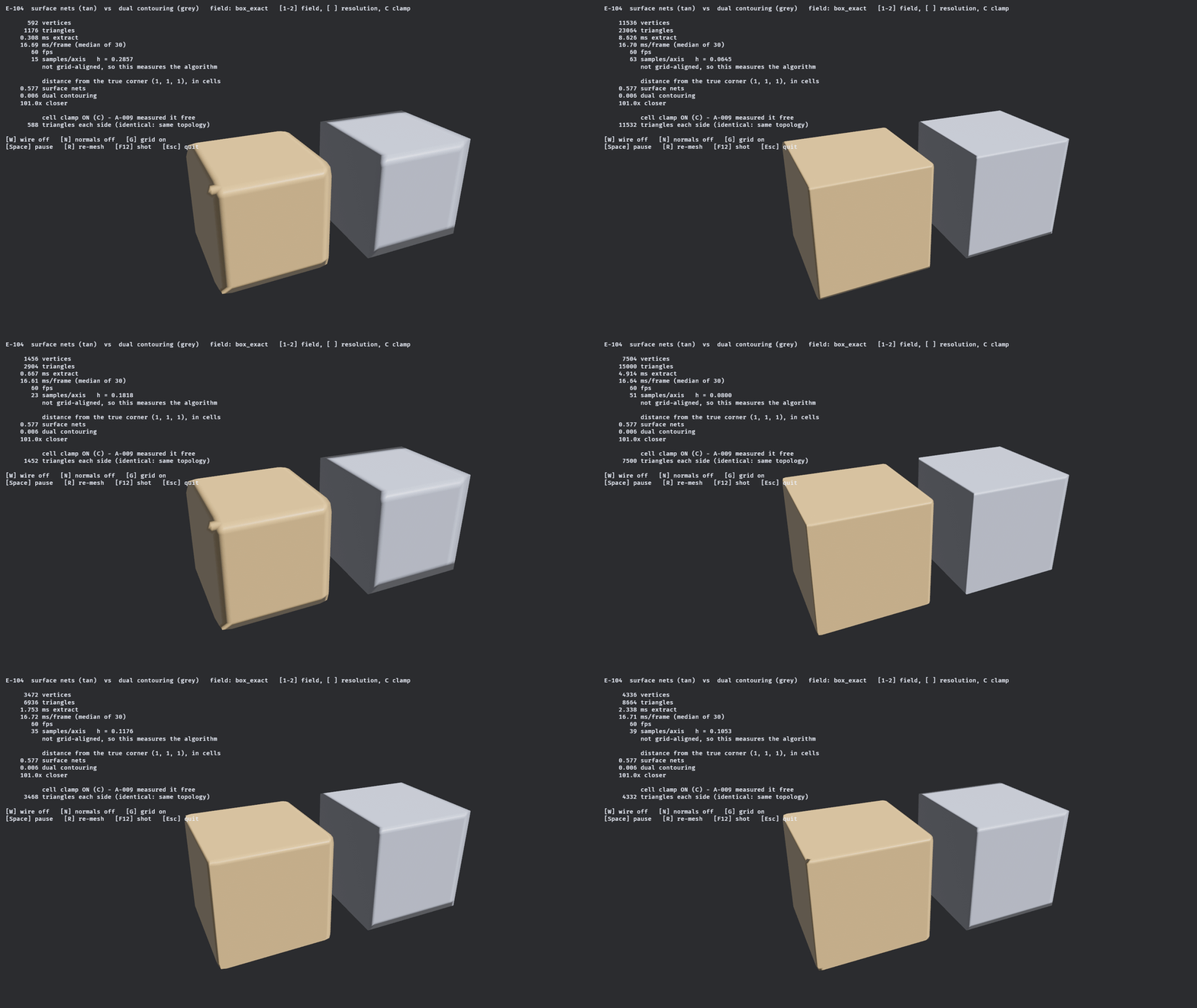
dual_contouring_cube — the same box, the same 19³ grid, the same edge crossings. Surface Nets on the left, Dual Contouring on the right. The only difference between the two meshes is one function: where a cell's vertex goes. Both emit 972 triangles with identical connectivity. On csg_difference the concave seam holds too.
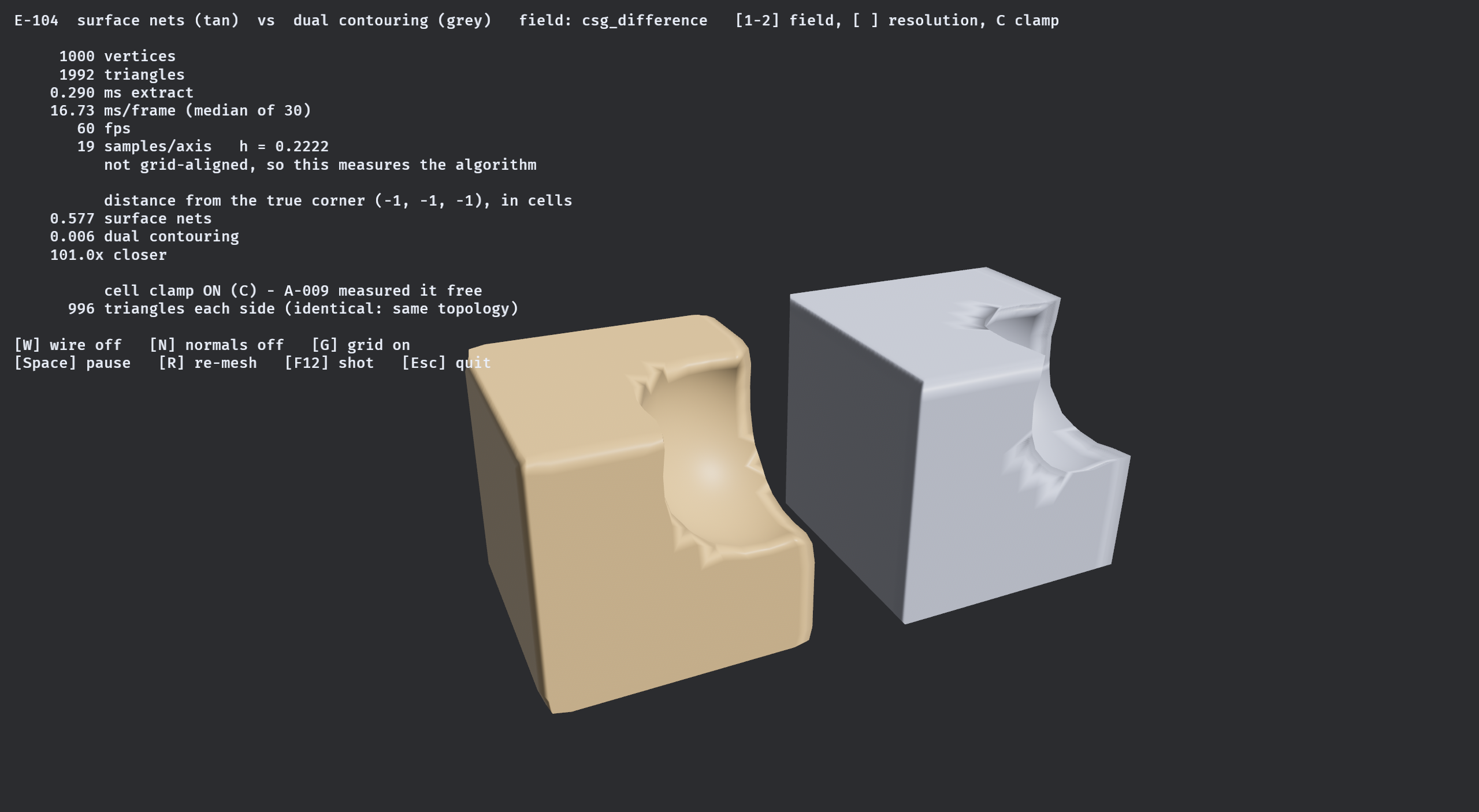
The corners are the real difference, and dual contouring is what closes them. Measured on box_exact at 27³ — a resolution deliberately not aligned to the box faces, since on an aligned grid this measures the sign-classification rule rather than the algorithm:
nearest vertex to the corner (1,1,1) |
world | cells |
|---|---|---|
| Surface Nets | 0.0888 | 0.58 |
| Dual Contouring | 0.0009 | 0.01 |
Guaranteed intersection-free extraction turns out to be free for placement, and not sufficient overall — which is not what the folklore predicts in either direction. Confining each solved vertex to its own cell drives self-intersections to exactly zero on five of the eight test fields — torus goes 2.66 → 0 pairs per 1,000 triangles — and the corner above measures identically clamped or not, because a convex corner's solution is already inside its cell. What survives the clamp is 3.12 on the gyroid and 13.84 on fbm terrain, and those are precisely the two fields where two sheets of surface share a cell: a connectivity defect, not a placement one.
It costs about 3% over Surface Nets to do it, and the two meshes are otherwise the same mesh: identical index buffers, and 864 of 1016 vertices agreeing to within 2e-15 cells. Only the 152 on edges and corners move.
Letters thinner than a voxel
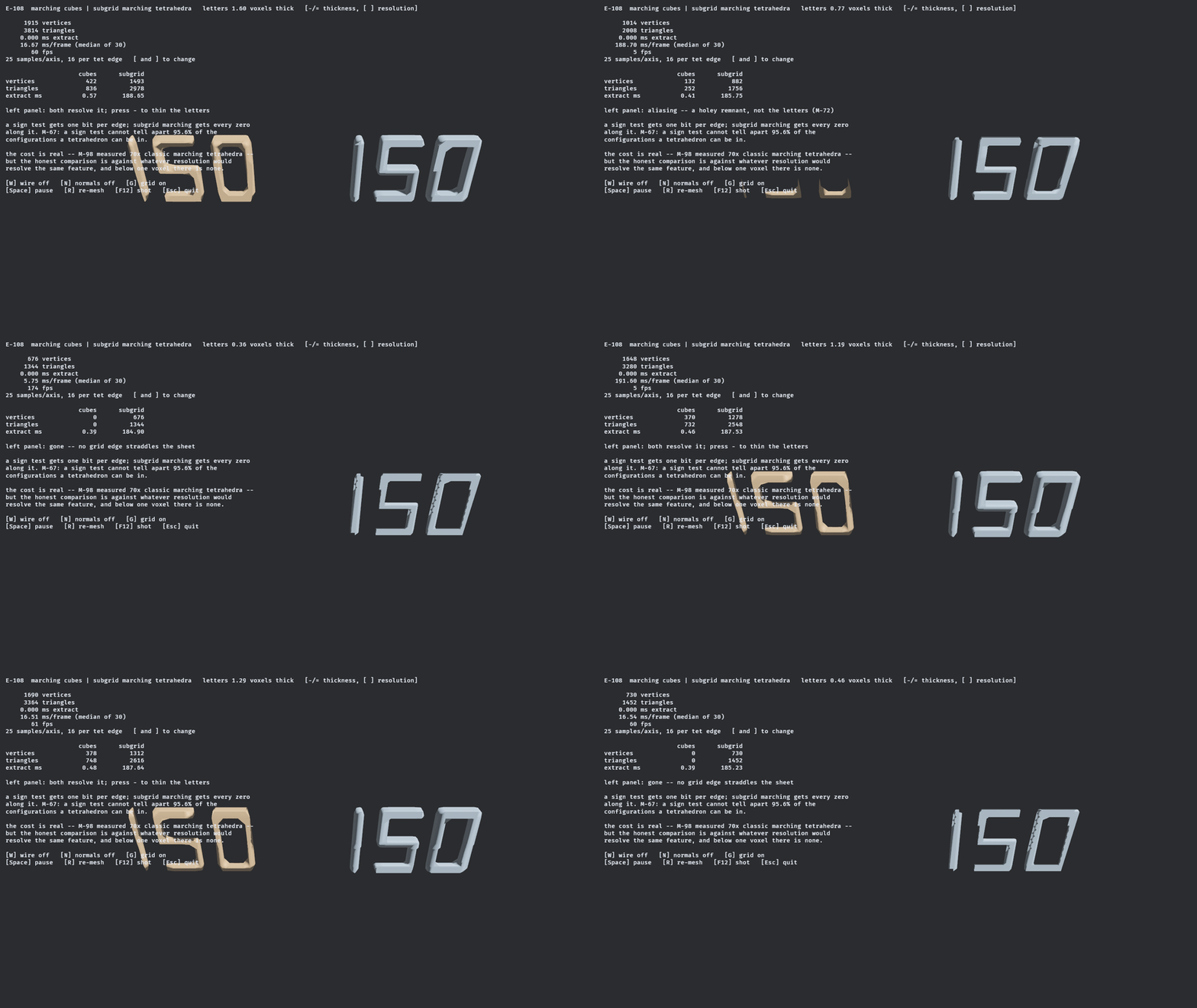
One field, one grid, two extractors, and a sweep driving the letters from 1.6 voxels thick down to 0.2. On the left, Marching Cubes: first a holey remnant, then nothing at all. On the right, subgrid Marching Tetrahedra, unchanged.
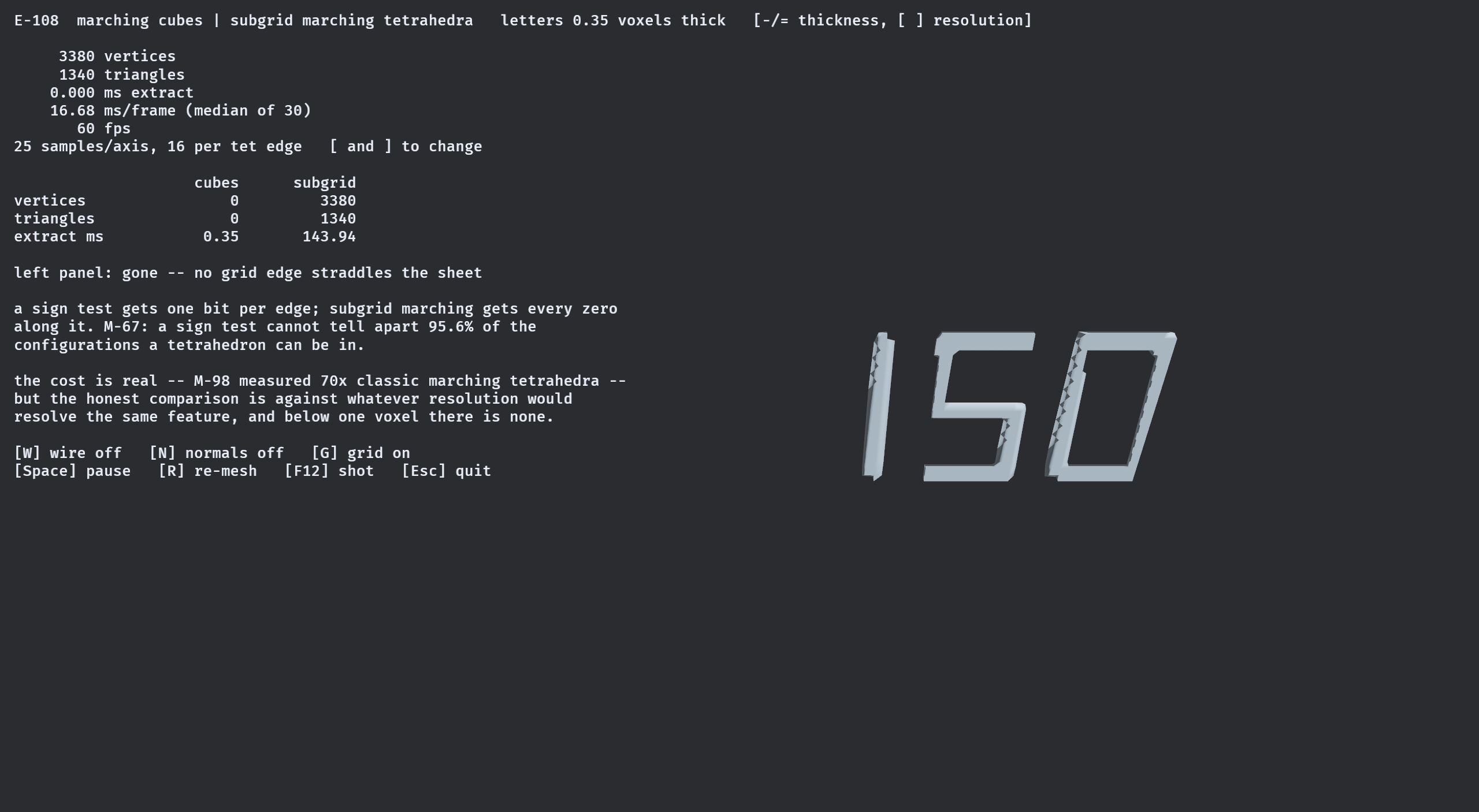
The same thing standing still, with the numbers. The letters are 0.35 voxels thick. Marching Cubes returns 0 triangles; subgrid marching tetrahedra returns 1,340.
Every other method here asks one question per grid edge — what sign is this endpoint — and gets one bit back. A feature thinner than a cell fits between the samples and there is no answer that could describe it. M-67 puts a number on the gap: a sign test cannot distinguish 95.6% of the configurations a tetrahedron can actually be in.
Subgrid marching asks instead for every zero along the edge, and triangulates whatever comes back — however many crossings there are. Push the thickness up and Marching Cubes does not recover cleanly; it passes through a holey remnant first (220 triangles at 0.70 voxels), which is M-72's aliasing and the failure mode a streamed world actually suffers. A feature that vanishes at a known distance can be faded. One that disintegrates into a resolution-dependent scatter pops.
It is not free: M-98 measured it at 70× classic Marching Tetrahedra, and the constant is field evaluations rather than anything algorithmic — 576 per cell at 16 samples per edge against Marching Cubes' 8 shared corner samples. But the comparison the HUD invites is the wrong one. The right one is "against whatever grid resolution would resolve the same feature", and below one voxel there is none.
cd bevy_isomesh && cargo run --example subgrid_features --release
- = thickness · [ ] resolution · W wireframe.
Seven algorithms, one process, one run
No paper since 2020 benchmarks Marching Cubes against Surface Nets against Dual Contouring, and Surface Nets has no credible published timings at all. So they are measured here — eight fields, two grids, seven algorithms, one process — and the headline is not what the folklore says.
The timings moved by 4.26× on 2026-08-16 and the numbers below do not include it. Two
optimisations — a const-generic loop axis and an odd sample row stride — took Surface Nets at 256³
from 693.8 ms to 162.7 ms and its IPC from 1.20 to 4.09, without changing a triangle. The
SN/MC ratio went from 5.43× to 1.26×, and Surface Nets is now faster than Marching Cubes at
16³, 24³ and 32³. See the experiments page;
docs/measurements/family.csv is the current run.
Correctness is unaffected — that is what "not one triangle changed" means — so the table below stands:
| manifold | intersection-free | |
|---|---|---|
| Marching Cubes | ✅ | ✅ |
| Marching Cubes + decider | ✅ | ✅ |
| Marching Tetrahedra | ✅ | ❌ 3.405 / 1k on csg_difference |
| Surface Nets | ❌ 128 edges | ✅ |
| Dual Contouring | ❌ 128 edges | ❌ 13.837 / 1k on fbm_terrain |
| Manifold Dual Contouring | ✅ | ❌ 15.434 / 1k on fbm_terrain |
Three of the four corners of that 2×2 are occupied, and the crude baseline holds the good one. What Dual Contouring buys instead is accuracy exactly where the features are sharp — symmetric Hausdorff at 65³ against Marching Cubes: box_exact 101× better, thin_plate 77.9×, against sphere 1.2× and torus 1.6×. Two orders of magnitude on a corner and nothing at all on a sphere.
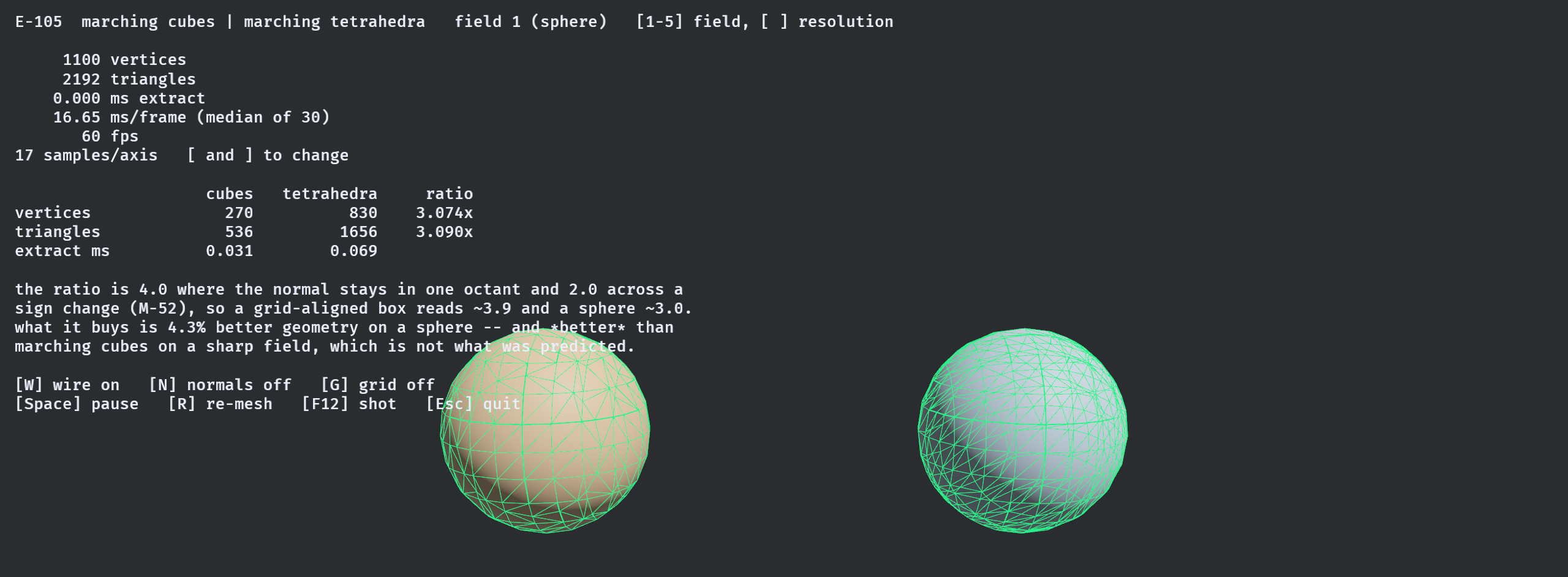
marching_tetrahedra — one sphere, one 17³ grid, two algorithms. 270 vertices against 830, 536 triangles against 1,656. The wireframe is on by default because that is the only place the difference lives.
Marching Tetrahedra costs 2.87–3.91× the triangles — the published "2–3×" covers only the two roughest fields — for 4.3% worse geometry, where the source it is usually attributed to reads far stronger than that. And it is better than Marching Cubes on sharp fields, because its extra edge families sample a corner from more directions.
cargo bench --bench shootout # writes docs/measurements/shootout.csv
The blocky path, and a published number that is one scene's
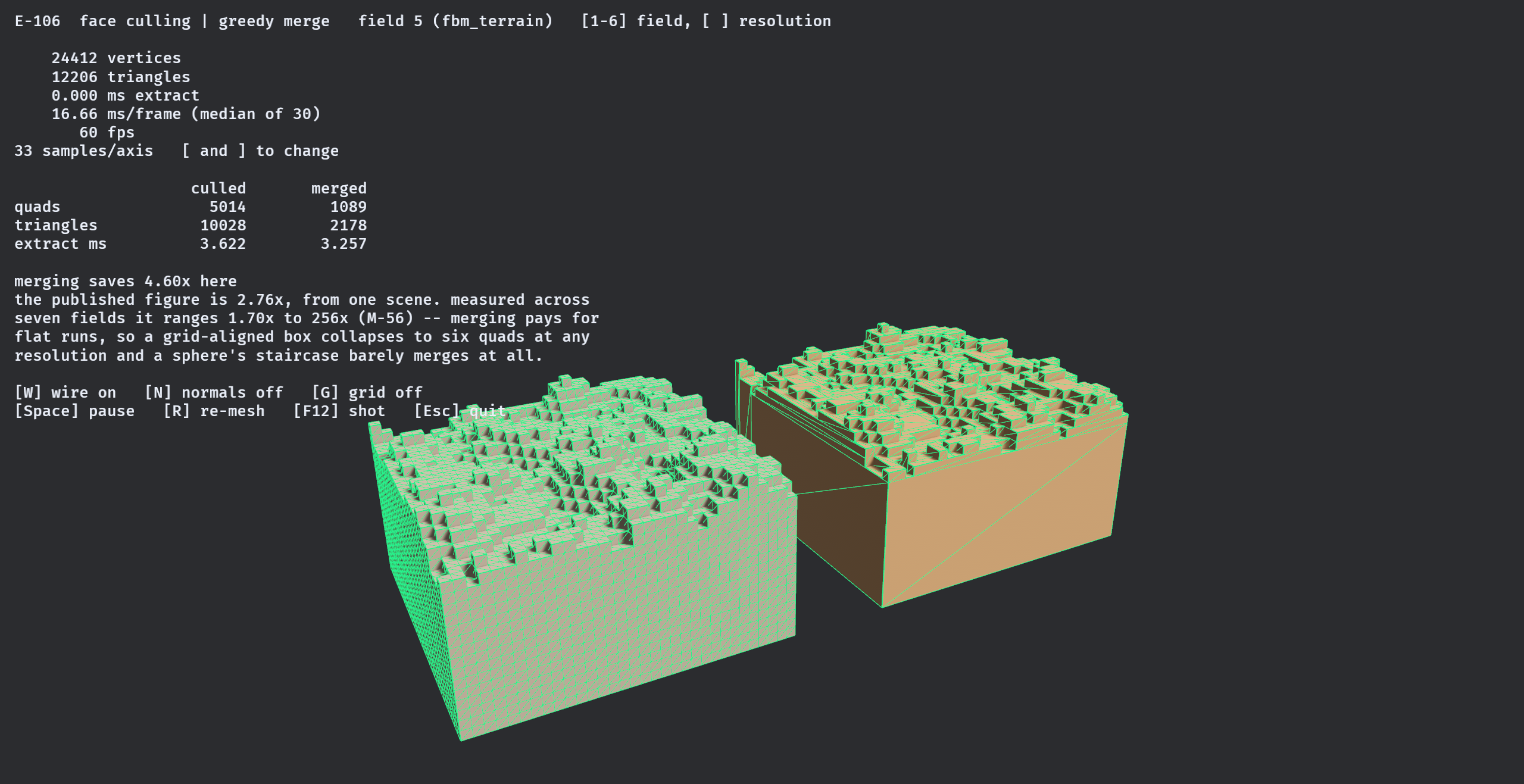
greedy_quads — the same fBm terrain and the same occupancy, meshed twice. Left, one quad per visible cell face: 5,014 quads. Right, coplanar runs merged: 1,089, and that side wall is two triangles. The wireframe is the demo, because the two surfaces are identical.
Greedy meshing is quoted everywhere as 2.76× fewer triangles than face culling, from one UE5 benchmark. Measured across eight fields at one resolution, it is not a constant:
gyroid |
sphere |
torus |
fbm_terrain |
csg_difference |
box_exact |
|---|---|---|---|---|---|
| 1.70× | 1.94× | 2.69× | 4.60× | 10.64× | 256× |
Merging pays for flat runs. A grid-aligned box collapses to six quads at every resolution — twelve triangles at 17³, 33³ and 65³ alike — while a sphere's staircase is short runs and barely merges. The published figure happens to land beside torus. This was predicted before the measurement, for exactly that reason.
Two limitations are on display rather than hidden. thin_plate returns zero triangles: it is 0.4 cells thick and this algorithm asks one question per cell, so a feature thinner than a cell does not exist to it. And the mesh is deliberately open — a cube corner needs three normals, so vertices are split, and welding closes it everywhere except a T-junction, where a long quad butts against several short ones and the vertex they meet at simply is not on the long quad's edge.
cd bevy_isomesh && cargo run --example greedy_quads --release
1–6 field · [ ] resolution. Press 2 then ] to watch the right panel stay at twelve triangles while the left one grows.
The sharpness knob, and what it costs at both ends
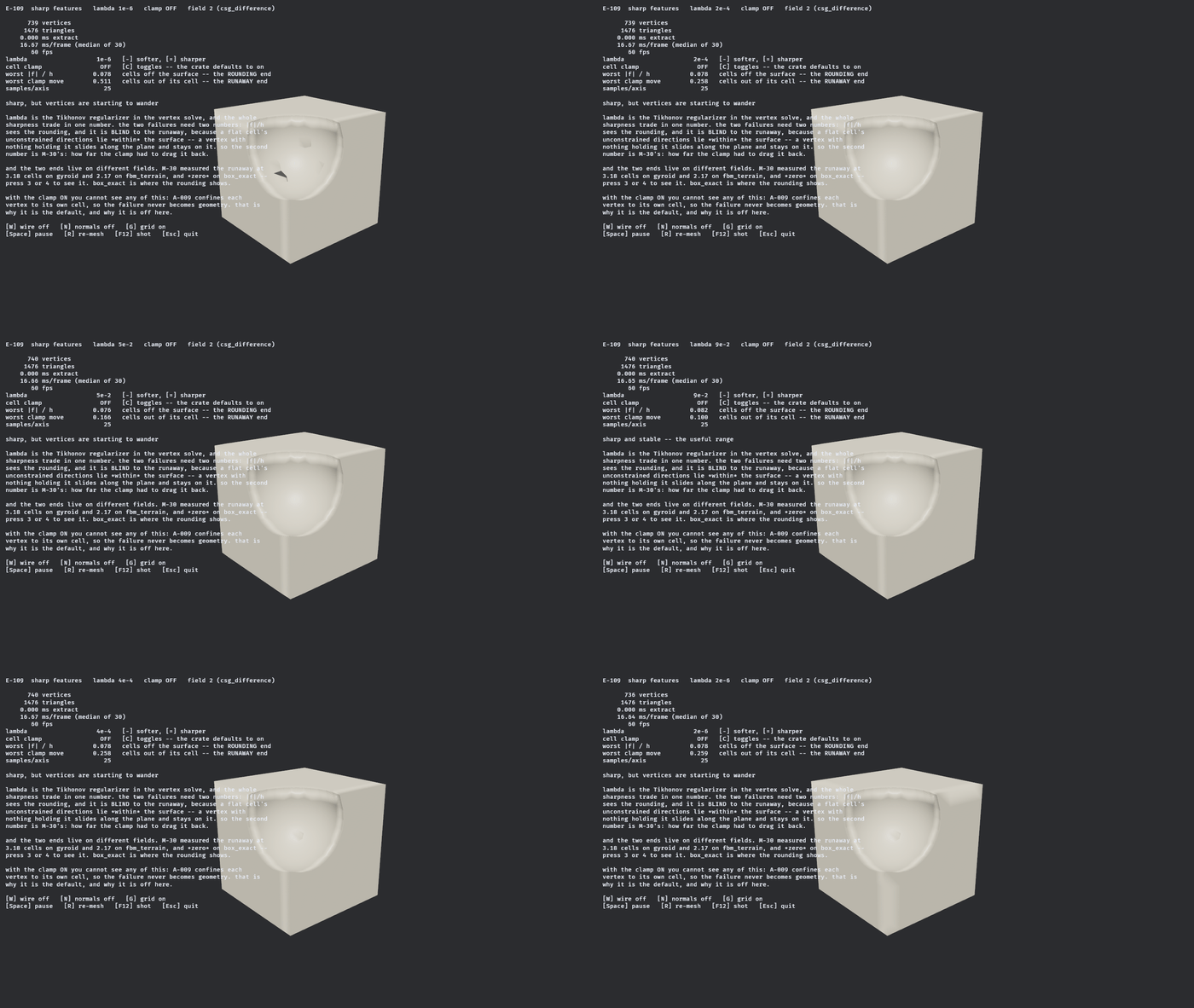
sharp_features — one model, a live slider on λ, the Tikhonov regularizer in the vertex solve. It
is the whole sharpness/stability trade in one number, and it was a compile-time constant until this
demo needed to turn it.
Toward zero the solve is the unregularized plane intersection: a corner where three planes meet comes out exactly, which is the entire reason to run Dual Contouring rather than Surface Nets. But a flat cell has a rank-1 system, nothing determines its vertex along two directions, and with no regularizer holding it, it leaves. Toward large, every vertex is pulled to the centroid of its crossings, nothing flies anywhere, and every sharp edge rounds over.
On gyroid at 25³ with the clamp off, sweeping λ over six decades:
| λ | worst |f| / h | worst clamp move |
|---|---|---|
1e-6 |
10.54 | 18.03 cells |
7e-5 |
3.38 | 8.99 |
4e-3 |
2.24 | 3.41 |
5e-1 |
0.60 | 0.78 |
Two numbers, because the two failures are not the same failure and one metric cannot see both.
|f|/h is blind to the runaway exactly where it matters: a flat cell's unconstrained directions lie
within the surface, so an unheld vertex slides along the plane and stays on it. On box_exact at
λ = 1e-6 it reads 0.000 — a perfect-looking mesh with a vertex several cells from where it
belongs.
And the field matters as much as the metric. That same box_exact sweep gives 0.000 runaway at every
λ, because M-30 measured this failure on gyroid and fbm_terrain and said plainly that "sphere,
box_exact and thin_plate have zero vertices outside". Press 3 for the field that shows it (M-107).
The clamp is off by default here and only here: A-009's cell clamp confines every vertex to its own cell, so with it on none of this is visible. That is why it is the crate's default.
cd bevy_isomesh && cargo run --example sharp_features --release
- = λ · C clamp · 1–4 field · [ ] resolution.
What the clamp removes, and the half it cannot reach
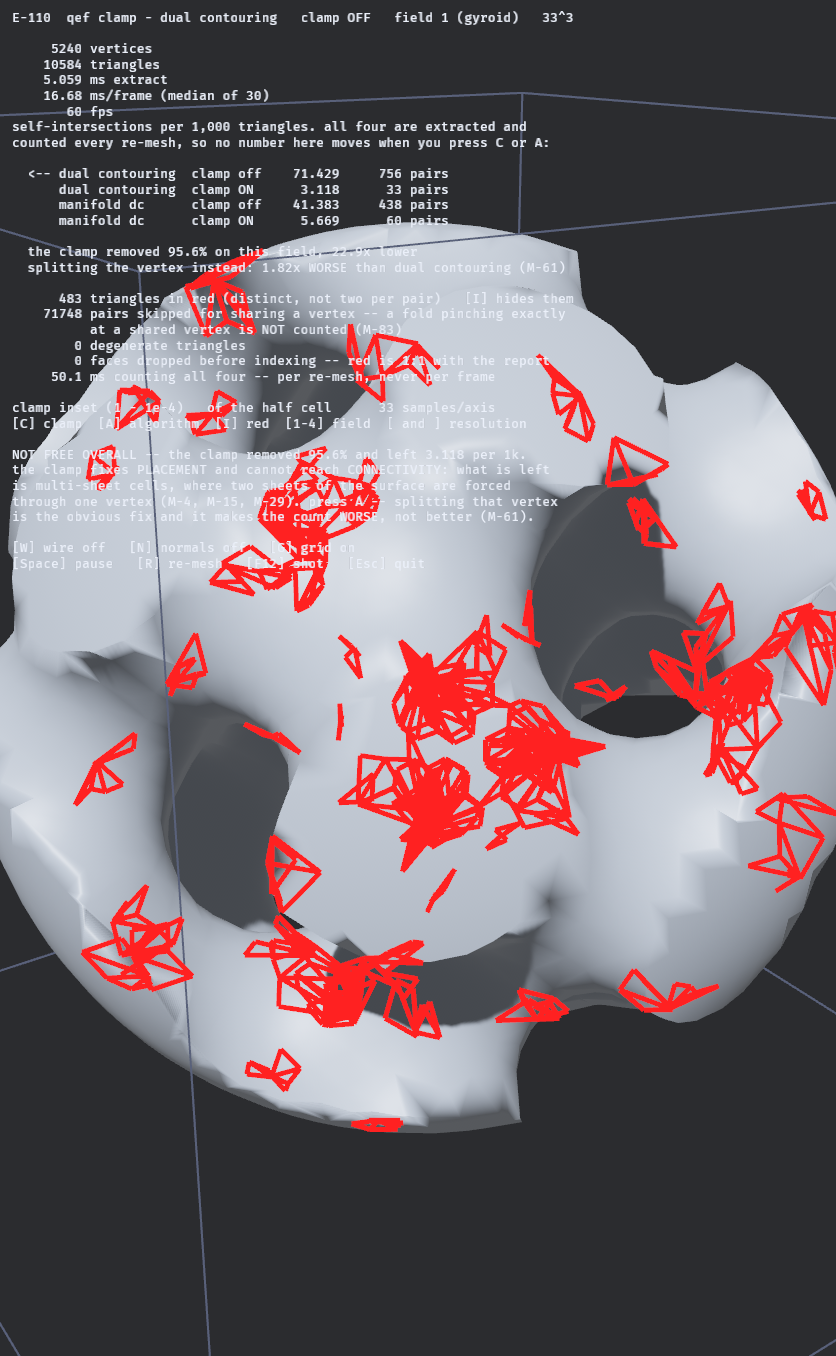
Every red outline is a triangle the self-intersection counter caught folding through another one. Same mesh, same λ; the only thing that changes below is whether each vertex is confined to its own cell.
The clamp is the cheapest correctness win in the crate and it is not a complete one, which is the whole content of this demo. On the capped gyroid at 33³:
| clamp off | clamp on | |
|---|---|---|
| dual contouring | 71.429 | 3.118 |
| manifold dual contouring | 41.383 | 5.669 |
Pairs per 1,000 triangles. The clamp removes 95.6% of them and leaves 3.118 — and what it leaves is
not a smaller version of the same problem. Five of the eight fields measured (the roster before R-177) go to exactly zero;
torus reads 2.66 → 0. The two that don't are gyroid and fbm_terrain, which are precisely the
fields with cells carrying two sheets of surface. That residue is a connectivity defect, and no
constraint on where a vertex sits can reach it.
Press A for the part that is genuinely counter-intuitive. Splitting the shared vertex is the obvious
fix, and Manifold Dual Contouring makes the count worse — 3.118 → 5.669, 1.82×. The clamp's
guarantee assumes one vertex per cell, and two vertices in one cell is exactly the assumption being
dropped.
Two things the picture is not claiming. The counter never compares triangles that share a vertex
index, and dual contouring's quads share vertices across every cell face — 71,748 pairs are skipped on
this mesh, against 756 found, so a fold pinching exactly at a shared vertex draws no red. And the red
outlines come from the validator's own pairs, mapped back through a rebuilt copy of its face filter
that refuses to draw at all if the two disagree; nothing here forms a second opinion about what counts
as an intersection.
Sweeping resolution splits the two fields apart, which was not the prediction. On gyroid the clamped
residue falls with finer cells, 7.14 at 17³ to 1.12 at 49³ — multi-sheet cells are a resolution effect,
so resolving them removes them. On fbm_terrain it does not move: 25.40 at 17³, 20.43 at 49³, wandering
without direction in between. fBm has detail at every scale, so refining the grid uncovers new sub-cell
features exactly as fast as it resolves the old ones.
cd bevy_isomesh && cargo run --example qef_clamp --release
C clamp · A algorithm · I red · 1–4 field · [ ] resolution.
Two failures, two laws, and neither one is where you would guess
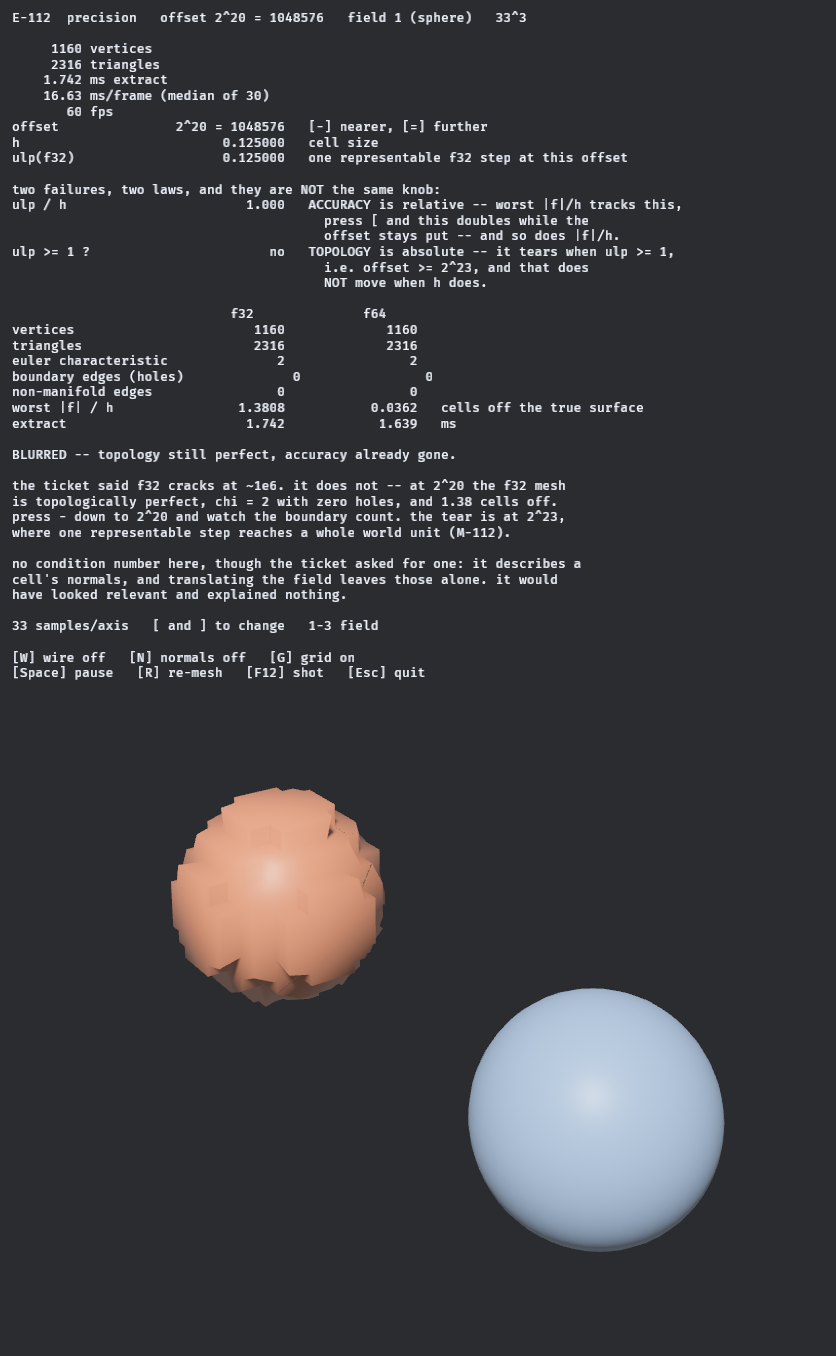
The same unit sphere, the same grid, the same code — f32 on the left, f64 on the right, both
translated to 2²⁰ ≈ 1.05e6 and moved back for display. Identical topology: 1,160 vertices, 2,316
triangles, χ = 2, zero holes on both. The lumps are the entire difference.
This is what "CAD needs f64" actually looks like, and it is two failures rather than one.
Accuracy is relative. The worst distance from a vertex to the true surface is set by
ulp(offset) — the gap between neighbouring f32 values out there. Expressed in cells it is
ulp/h, so a finer grid is hurt more by the same offset. Measured at 2²⁰: 1.3808 cells for
f32 against 0.0362 for f64, a 38× gap with the mesh still topologically perfect. At a fixed
offset, halving h exactly doubles the error in cells — 3.1010 → 6.2020, 4.0000 → 8.0000,
5.8564 → 11.7128 from 33³ to 65³.
Topology is absolute. Push out to 2²³ = 8,388,608, where one representable step reaches a whole
world unit, and the mesh tears:
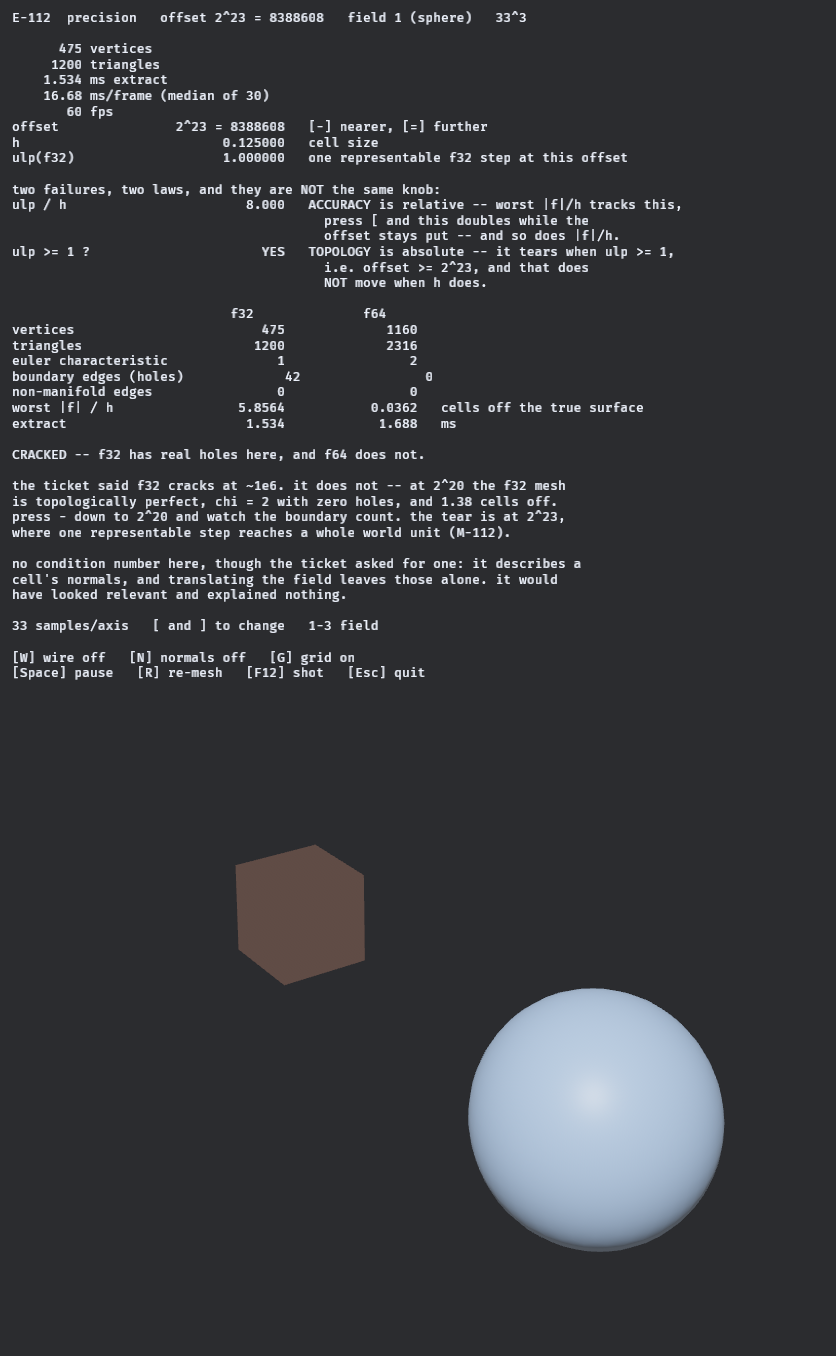
χ drops 2 → 1, the vertex count collapses 1,160 → 475, and 42 boundary edges appear — real
holes. That threshold does not move when the cell size does, which is what makes it a different
law from the first. The proof is one fixture: at 65³ and ulp/h = 8 the mesh is clean, while at 33³
and the same ulp/h = 8 it is torn. Neither number predicts the other.
The ticket for this demo was wrong, and measuring first is why the demo is not. It asked for
~1e6 offsets where "f32 cracks" — at 1e6 f32 does not crack, as the first image shows. It also
asked for the QEF condition number in the HUD, which describes a cell's normals and is very nearly
unchanged by translating the field; it would have sat there looking relevant and explaining nothing.
Two other suspects were ruled out before anything was built: re-validating the same f32 vertices
after recentring in f64 gives bit-identical reports, so the holes are in the mesh and not in the
validator's lattice, and an analytic gradient changes nothing, so Sdf::gradient's |p|-scaled step
is not involved (M-112, M-113).
cd bevy_isomesh && cargo run --example precision_f32_vs_f64 --release
- = offset · [ ] resolution · 1–3 field.
What the vertex solve actually sees
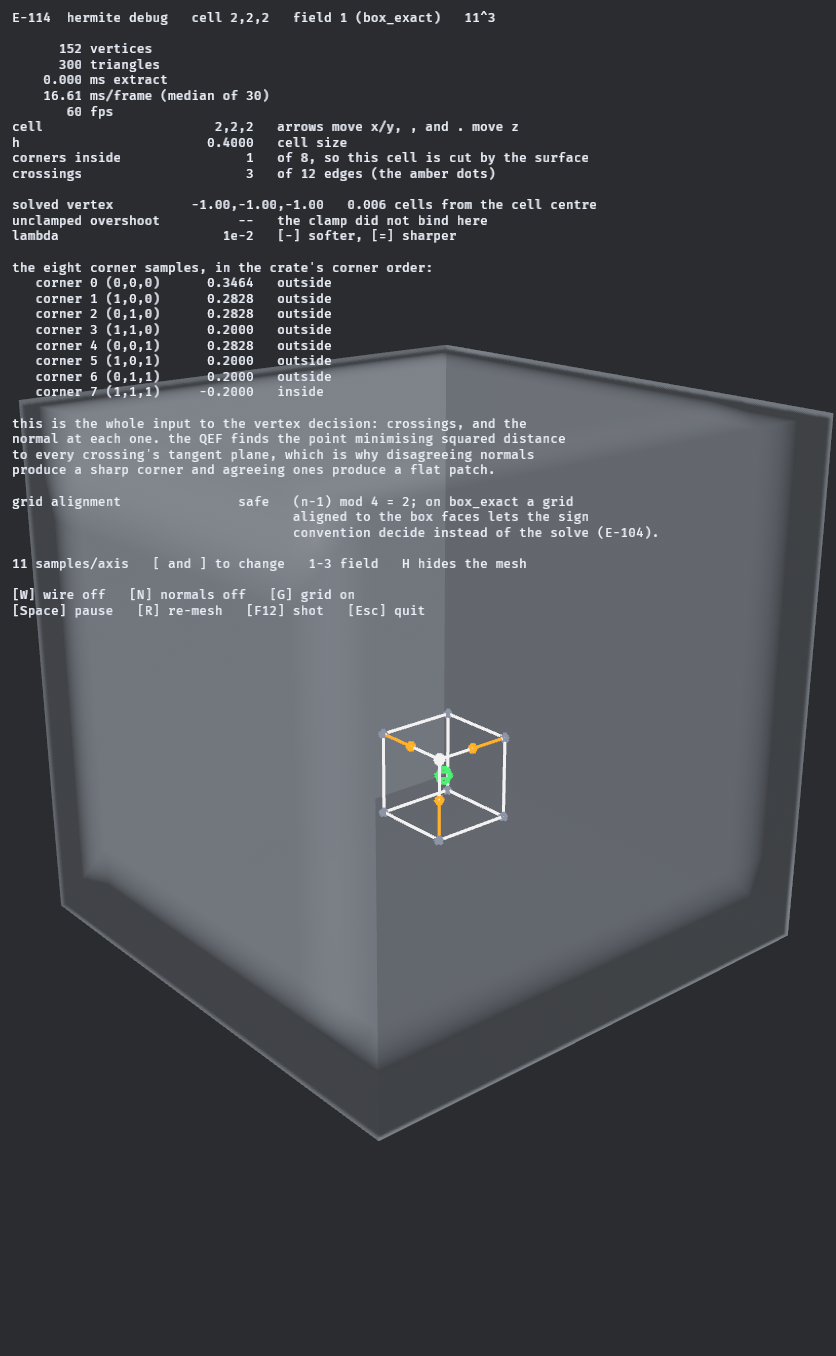
One cell at a corner of box_exact. Three amber dots are the edge crossings, the amber lines are the
surface normal at each, the green dot is where the QEF put the vertex — exactly on the box corner — and
the white box is the cell.
Dual Contouring's input is not the field. It is Hermite data: where the surface crosses each of a cell's twelve edges, and the normal at each of those points. Everything the vertex decision knows is in that picture, which is why disagreeing normals produce a sharp corner and agreeing ones produce a flat patch.
The demo picks the cell for you, and how it picks is the interesting part. The obvious score — the
cell whose unclamped solve sits furthest from its own centre — is M-30's quantity, and M-30 also records
that box_exact has zero vertices outside their cells. So on this demo's default field that score
is about 0.006 everywhere and the winner is chosen by floating-point noise. It landed on a corner
anyway, which is exactly how a broken heuristic survives review. The score is now normal disagreement,
1 − |mean(normals)|: zero on a flat patch, 0.42 on a box corner.
Two other things this example had to get right rather than assume. HermiteCell::from_corners is public
while the corner order it requires is private, so the example duplicates the layout and then verifies
it against the crate at startup — and that check is mutation-tested, because swapping x and y still
yields four crossings and would pass a check that only counted them. And the first draft defaulted to
13³, which is precisely E-104's grid-aligned trap for box_exact: the demo opened on the degenerate
case it exists to explain. The resolution step is now arithmetic that cannot land on one.
cd bevy_isomesh && cargo run --example hermite_debug --release
Arrows move the cell in x/y · , . in z · - = λ · [ ] resolution · 1–3 field.
Where an algorithm breaks, measured rather than described
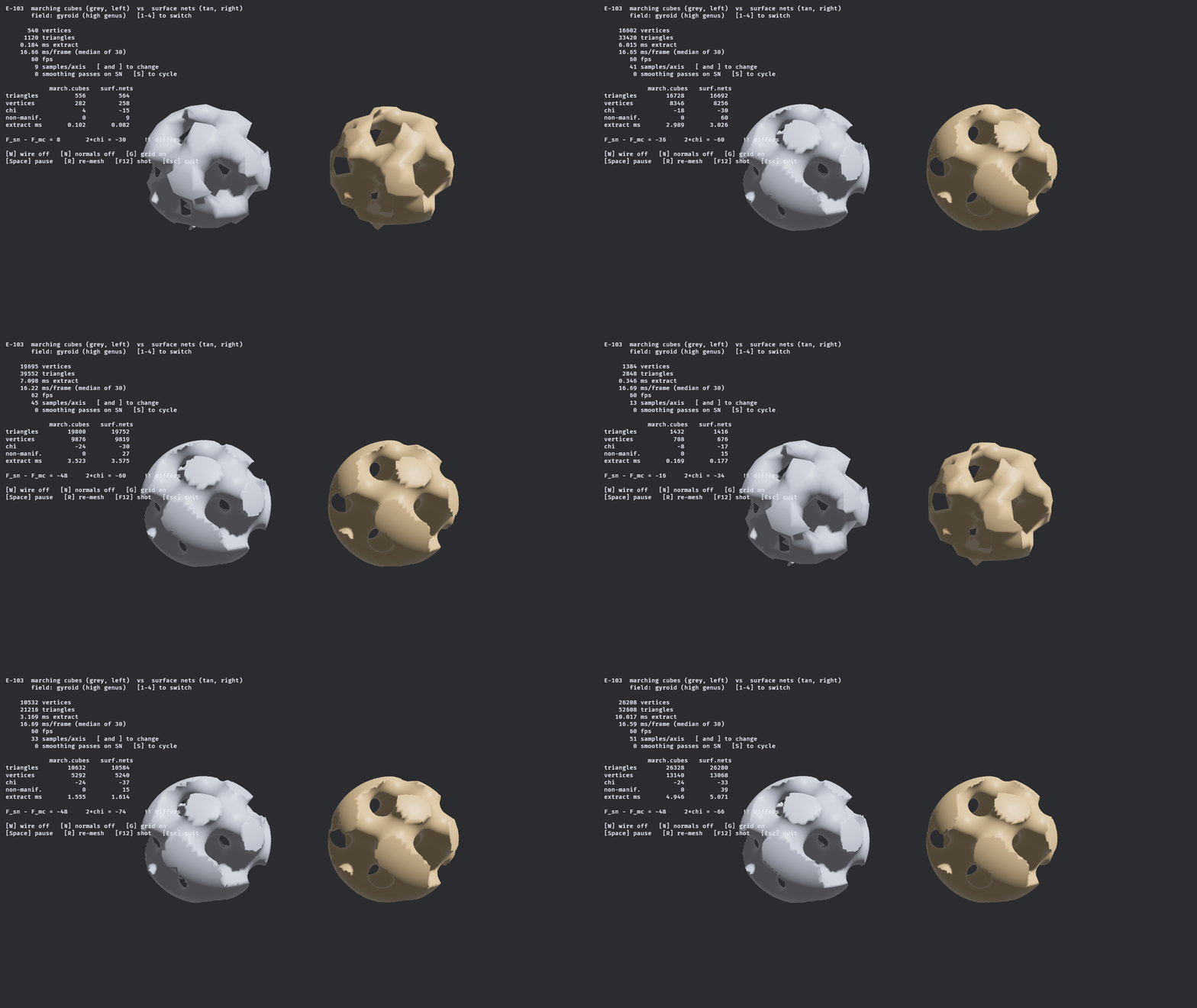
The capped gyroid — triply periodic, high genus. Marching Cubes stays manifold here; Surface Nets does not.
Surface Nets places exactly one vertex per cell. Where two sheets of the surface pass through the same cell they are forced to share it, and the result is non-manifold — 42 non-manifold edges at 25³ in the sequence above, against Marching Cubes' zero at every resolution in it. The literature review calls this dual contouring's "actual structural defect". It is fixed below, and the fix has a cost that is also measured.
Notice that the Euler identity now reads !! differs. That is correct: the identity's precondition is a closed manifold, and Surface Nets' output here is not one. The condition under which the assertion should fail is recorded next to the assertion, so when it does fail nobody mistakes it for a regression.
This is the crate's actual pitch. Not "the meshes look right" — a wrong mesh looks right — but that every mesh is measured, the measurements are in the test suite, and the ones that contradict the documentation are written down.
The hyperdeterminant in every cell
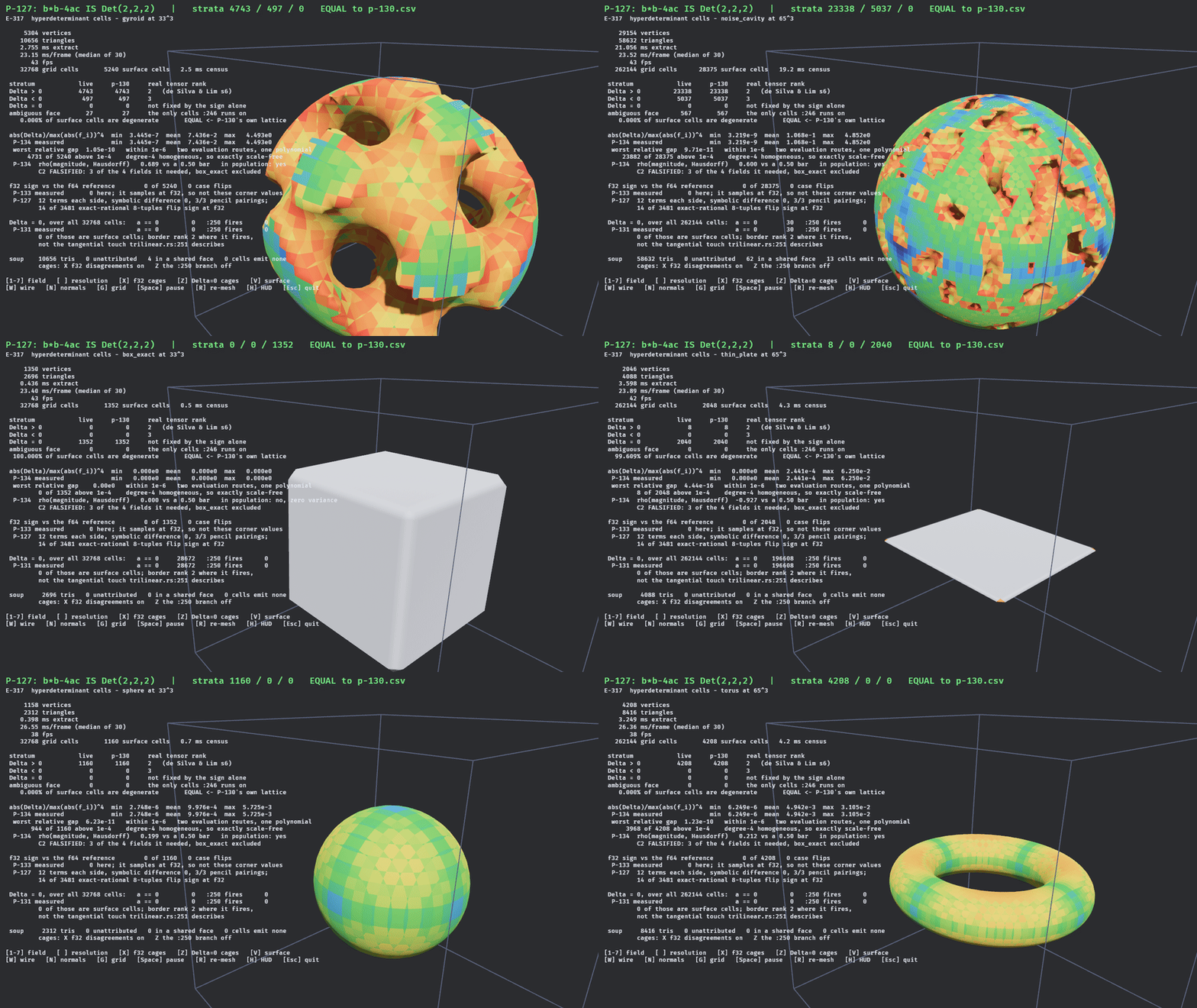
hyperdeterminant_cells
walks fourteen reference fields and shows the phase's headline as a picture: b*b - 4*a*c at
trilinear.rs:246 is identically Cayley's 2×2×2 hyperdeterminant (P-127, all three clauses held
— symbolic_difference_is_zero true, 12 terms against 12, all three pencil pairings agreeing, exact
deviation 0/1 over 3,481 trials). Colour is the scale-free magnitude |Δ| / max|fᵢ|⁴; grey is the
Δ = 0 stratum; magenta cages are cells whose f32 sign disagrees with the exact one.
The panel compares this run's (Δ > 0, Δ < 0, Δ = 0) partition against docs/experiments/p-130.csv
for the same field and resolution, and P-131's branch-fire counts against p-131.csv. P-130's two
falsifications are printed rather than hidden: delta_zero_share reaches 1.000000 on box_exact
(a polyhedron's surface cells sit exactly on the hyperdeterminant hypersurface), and C2's mutual
information is unreachable because ambiguous = g(case) makes it a data-processing inequality.
Three periodic surfaces with a known topology
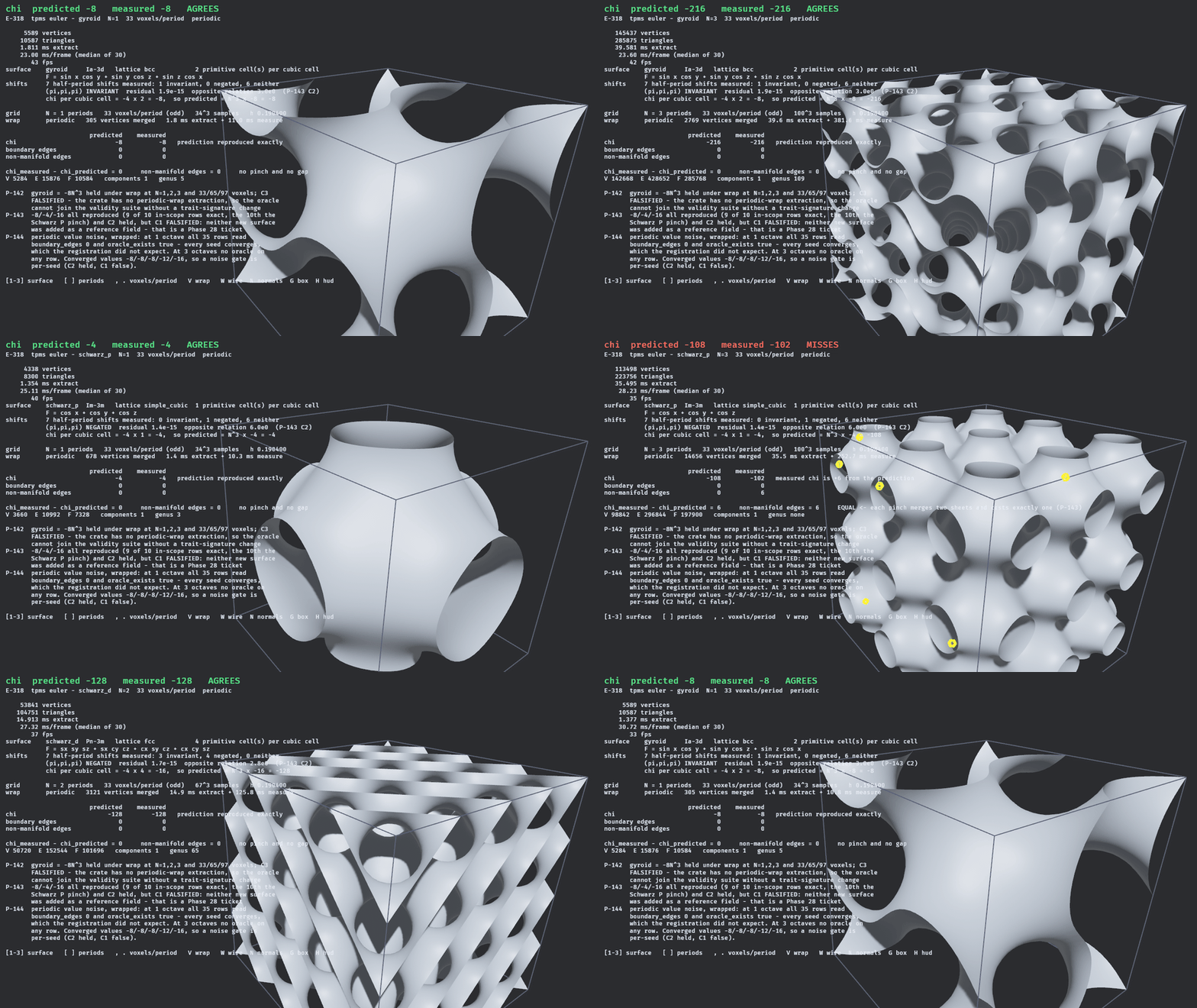
tpms_euler
shows the phase's three χ oracles: gyroid −8N³, Schwarz P −4N³, Schwarz D −16N³, counted from the
welded extraction and compared against a prediction derived live from a seven-half-shift symmetry
census — which is also why Schwarz P's lattice reads simple_cubic: its body-centring operation
negates F_P rather than translating it (P-143 C2, exact on 36 of 36 rows; P-142 C1 held
−8 / −64 / −216 to the integer). The 32-voxel rung is a labelled degenerate control — the π/4
lattice where Schwarz D cancels to exactly zero (M-48) — and there
chi_measured − chi_predicted equals its non-manifold edges exactly. The open arm is judged by its
boundary edges, never by χ.
The metric that costs more than it saves
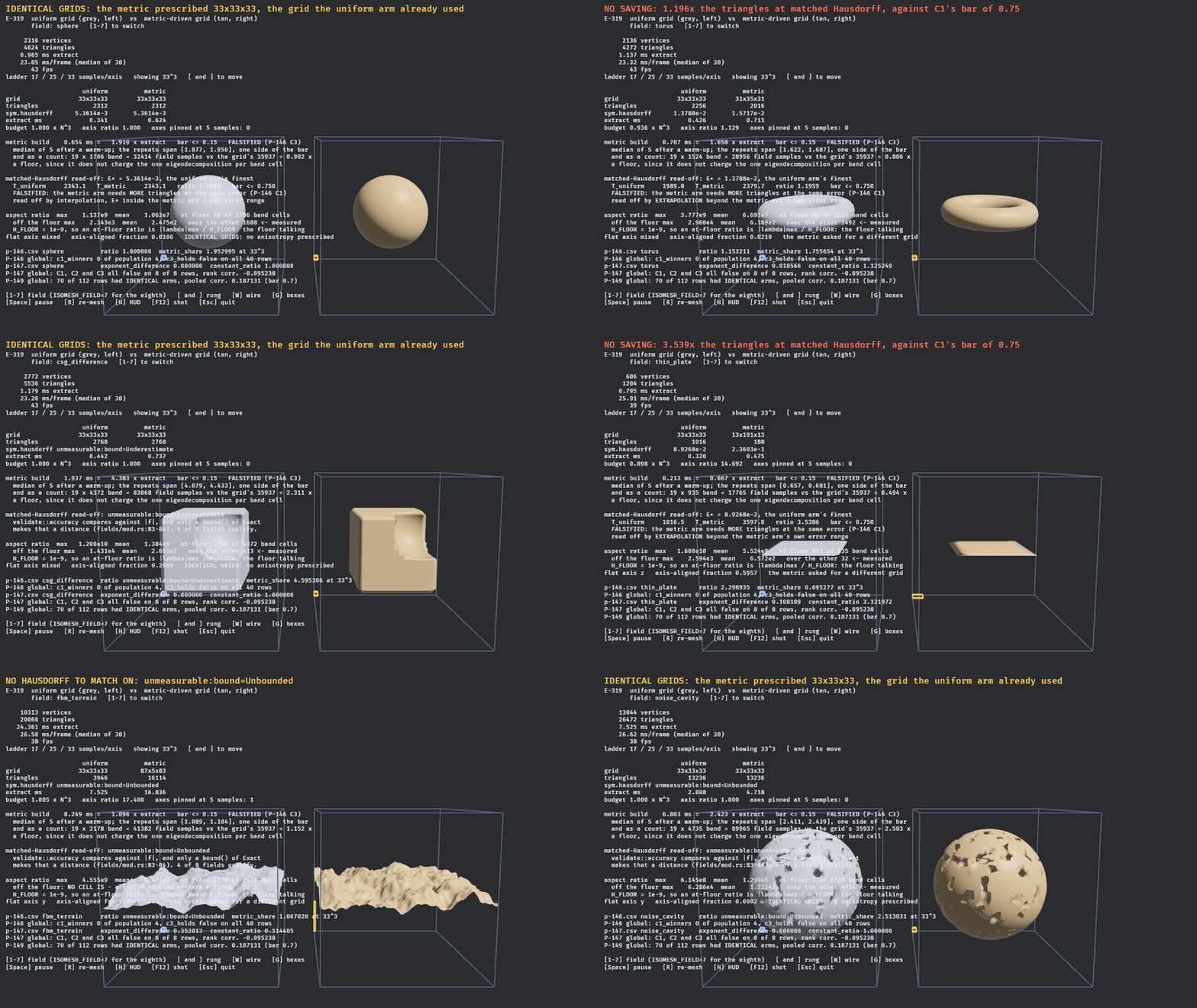
anisotropic_metric is the negative result, shown as one: P-146's C1 and C3 were both falsified —
no triangle saving at matched Hausdorff (2.299× dearer on thin_plate), and the metric build costs
0.17× of the extraction against a 0.15 bar. The aspect-ratio line carries its at-floor cell
count beside aspect_ratio_max, because at a flat direction the ratio is |λ|max / H_FLOOR ~ 1e9
and is a restatement of H_FLOOR rather than a measurement. P-147's all-false row and P-149's
70 of 112 identical arms ride along as citations.