isomesh
⚠️ Vibe Coded. Written by AI agents working from a human's direction, covered by tests rather than a line-by-line human review. Read the code before you rely on it for something you care about.
Signed distance field in, triangles out: isosurface extraction for Rust voxel games and CAD tools, with a Bevy plugin.



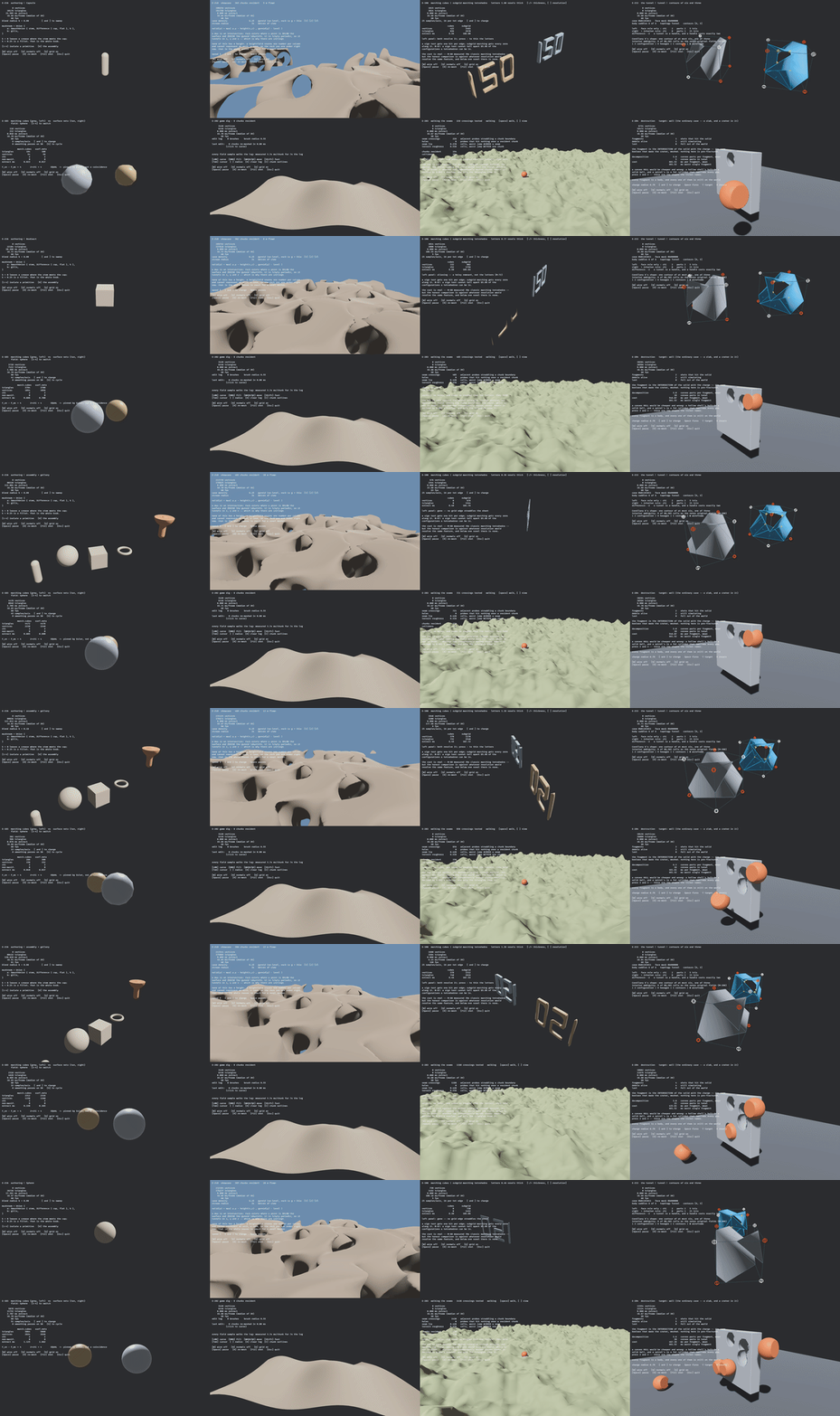
Eight examples, all recorded from this repository: a mushroom built by smooth union, caves and arches, letters thinner than a voxel, one cell meshed two ways, Surface Nets against Marching Cubes, a tunnel being carved, 495 chunk-seam crossings with zero holes, and a slab blown apart.
Status: experimental · Bevy 0.20 · MSRV 1.89 (isomesh), 1.97.1 (bevy_isomesh)
Why: it is the one isosurface crate that is no_std, generic over f32 and f64, extracts sharp features, and keeps every math library out of its public API, so a Bevy game and a CAD tool can share it without fighting over glam versions (the comparison).
Three crates live here: isomesh (the engine-free core, one dependency), bevy_isomesh (the Bevy plugin and every example) and isomesh-gpu (GPU extraction). An SDF (signed distance field) is a function that returns how far a point is from a surface, negative inside.
Quick start
cargo add isomesh
Implement Sdf for your field, or use one of the fourteen shipped reference fields, and extract:
use isomesh::marching_cubes::MarchingCubes;
use isomesh::{MeshBuffer, RuntimeShape3, Sdf};

struct Sphere;
impl Sdf for Sphere {
    type Scalar = f32;
    fn sample(&self, p: [f32; 3]) -> f32 {
        (p[0] * p[0] + p[1] * p[1] + p[2] * p[2]).sqrt() - 1.0
    }
}

let shape = RuntimeShape3::new([33; 3])?;
let mut mesh = MeshBuffer::<f32>::new();

// The buffer is caller-provided and reusable: `reset()` clears it without
// releasing capacity, because a real workload re-meshes thousands of chunks
// per edit and an allocation per chunk is the whole budget.
MarchingCubes::<f32>::new().extract(&Sphere, &shape, [-2.0; 3], 0.125, &mut mesh)?;

assert!(mesh.triangle_count() > 0);
# Ok::<(), isomesh::Error>(())
The lines starting with # are doctest plumbing: this block is the crate README's example, compiled on every cargo test, and scripts/readme_sync.sh holds this copy identical to it in CI. For Bevy, cargo add bevy_isomesh and see its README.
Try it
cd bevy_isomesh && cargo run --example game_showcase --release
It flies a camera through caves and arches that are meshed while it moves. Always --release: a debug build meshes 37–62× slower. Every example's command is in the guide.
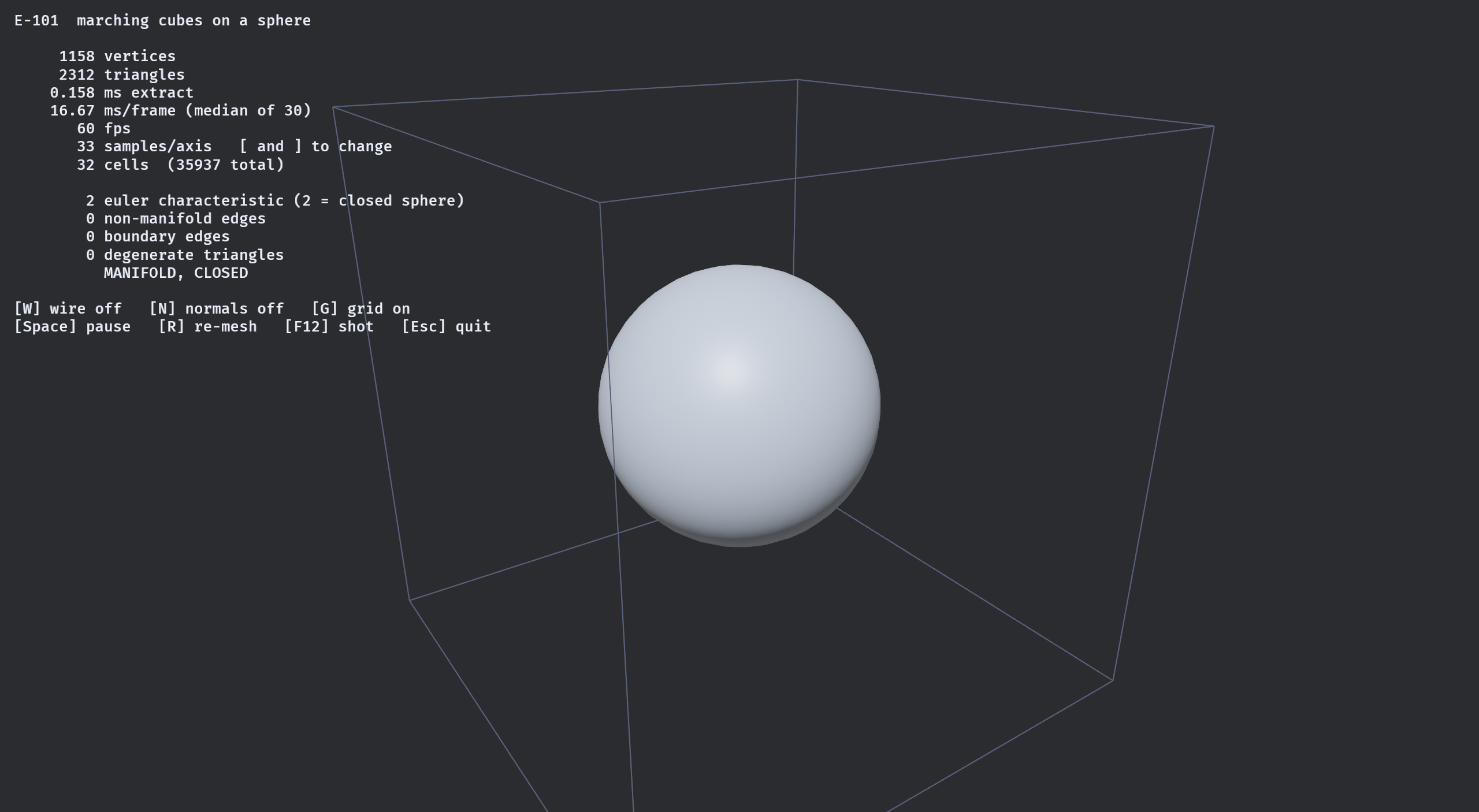
A still from marching_cubes_sphere: every picture here is regenerated from a command line (how).
What you can do
- Mesh a chunked voxel world that streams, digs and never cracks at a seam:
MarchingCubesandSubgridMarchingTetrahedratile across chunk seams with zero open edges, measured over 495 seam crossings: what it can do. - Pick from seven extractors: Marching Cubes (with MC33's tunnels), Surface Nets, Dual Contouring, Manifold Dual Contouring, Marching Tetrahedra, greedy quads, and subgrid Marching Tetrahedra, which sees features thinner than a voxel: the algorithms.
- Build fields from primitives and operators: smooth union, difference and fourteen reference fields, re-meshed as you edit: building a field.
- Check a mesh before you trust it: Euler characteristic, manifoldness, orientation, self-intersections, determinism and Hausdorff distance are public API: what gets checked.
- Extract on the GPU: above about 33³ the GPU path wins, by 37× at 129³ when the field is evaluated in the shader: gameplay.
- Run it in Bevy off the main thread:
bevy_isomeshmeshes on the task pool under a frame budget, with LOD and Transvoxel seams: the demos. - Know what is and is not done: what works, what does not yet, and the preregistered experiments behind the numbers: status, experiments.
Part of the Coven
isomesh is one of the Bevy Coven crates: the family table there says what each crate gives a game. The Cauldron, the Coven's editor, takes bevy_isomesh for caves, overhangs and carving: see use it in the Cauldron.
Bevy compatibility
bevy_isomesh |
Bevy |
|---|---|
| 0.0.13 | 0.20 |
isomesh and isomesh-gpu do not depend on Bevy.
Learn more
- docs.rs/isomesh and docs.rs/bevy_isomesh: the API.
- The book page, and the isomesh site with eleven demos playable in the browser.
docs/guide/: everything this README used to carry, in eight pages.- The demo page: all 54 examples, each with a capture, its command and its finding.
FINDINGS.md: what is believed, how strongly, and on what evidence;CHANGELOG.md.
Who and licence
Maintained by @Ladvien. Issues and pull requests are welcome at github.com/bevy-coven/isomesh/issues; read the org's CONTRIBUTING.md first.
MIT OR Apache-2.0, at your option.